Zenith, Mount Prospect, and Bill Shillington, W9ZCL
Here is a local radio story worth exploring. Zenith began with two Chicago wireless enthusiasts and an amateur call sign. A few years later, its WJAZ broadcast station placed two landmark towers in Mount Prospect. Decades after that, Mount Prospect amateur operator Bill Shillington, W9ZCL, showed how radio knowledge could support communities during disasters.
This is a focused chapter of Chicago-area amateur radio history, not a complete history of every local club or station. Thank you to John Thornton, KD9VZJ, for suggesting the topic.
Topic Snapshot
| Main subject | Zenith’s amateur-radio beginnings, WJAZ in Mount Prospect, and the later public-service work of Bill Shillington, W9ZCL |
|---|---|
| Location focus | Chicago and the former WJAZ transmitter site at Rand and Central Roads in Mount Prospect, Illinois |
| Early amateur call sign | 9ZN |
| Historic broadcast call sign | WJAZ |
| Mount Prospect amateur | Bill Shillington, W9ZCL |
| Post idea from | John Thornton, KD9VZJ |
| Audience | SARC members, visitors, and newer hams |
| Call to action | Learn more about Zenith Radio |
Amateur Radio Came Before the Zenith Name
Zenith traces its start to 1918, when Karl Hassel and Ralph H.G. Mathews began making radio equipment for other amateurs on a kitchen table in Chicago. Their business became the Chicago Radio Laboratory. The trade name “Z-Nith,” and later Zenith, came from the call sign of their amateur station, 9ZN.[1]
A call sign is the identifying combination of letters and numbers assigned to a radio station. Today, SARC uses N9RJV. In Zenith’s case, one early amateur call sign became part of a nationally recognized company name.
It is important to separate amateur radio from broadcasting. Amateur radio is built around licensed personal communication, experimentation, and service. WJAZ was a broadcast station that sent programs to a general audience. Zenith’s direct amateur-radio connection was the earlier work of Hassel and Mathews and their station 9ZN.
How WJAZ Reached Mount Prospect
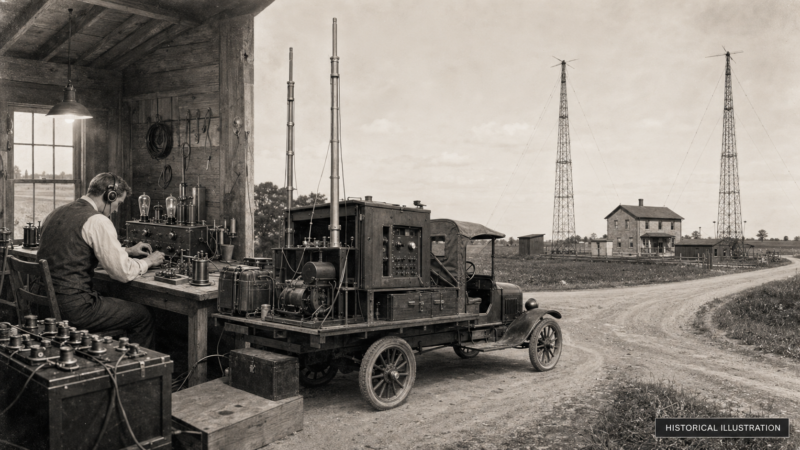
WJAZ began broadcasting from Chicago’s Edgewater Beach Hotel in 1923. Zenith later used a self-contained portable station mounted on a truck to test possible transmitter locations around Chicago. Mount Prospect offered open farmland and room for a high-power installation.[2]
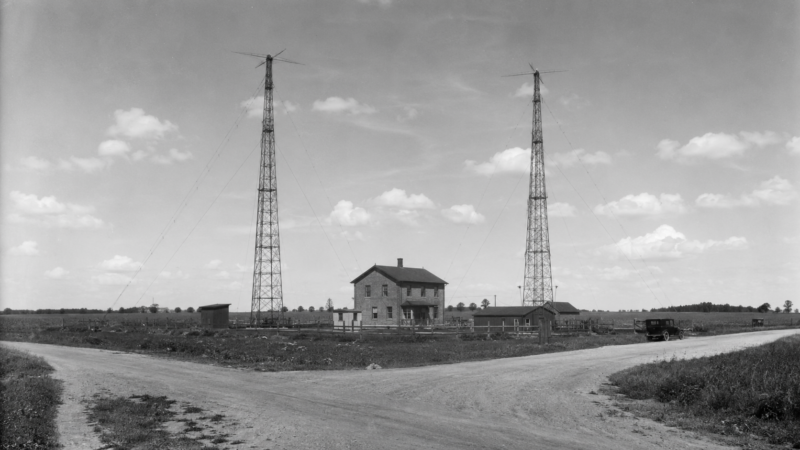
In 1925, Zenith built the WJAZ facility at Rand and Central Roads. The Mount Prospect Historical Society describes a two-story farmhouse between two towers, with a 5,000-watt, water-cooled transmitter inside. One tower displayed the word “Zenith” in red lights. The towers remained a familiar local landmark until the property was redeveloped in the 1970s.[2]
Why the WJAZ Court Case Mattered
In 1926, Zenith challenged the federal government’s authority to control WJAZ’s operating frequency under the Radio Act of 1912. The federal court found for the defendants because the older law did not give the Secretary of Commerce the claimed authority to restrict a station to an assigned wavelength.[3]
The WJAZ decision was an important part of a larger national problem involving crowded frequencies and weak regulation. It did not single-handedly create a new law. However, it exposed a major limit in the 1912 framework. Congress passed the Radio Act of 1927, which created the Federal Radio Commission to oversee broadcasting.[4]
For local radio enthusiasts, that makes the Mount Prospect site more than a lost landmark. It was connected to an important period in the development of American radio regulation.
Bill Shillington, W9ZCL: A Later Mount Prospect Service Story
A public call-sign record identifies William Shillington, W9ZCL, with Mount Prospect. Call-sign and license information can change, so readers should use the Federal Communications Commission (FCC) Universal Licensing System for current status.[5]
The Salvation Army reports that Shillington first volunteered with SATERN during the 1990 Plainfield tornado response. SATERN is the Salvation Army Team Emergency Radio Network. In 1995, he took a Salvation Army canteen, a mobile disaster-response vehicle, to earthquake-stricken Kobe, Japan. By 2016, he was overseeing SATERN operations in the Central Territory.[6]
ARRL, the national association for amateur radio, reported that Shillington, W9ZCL, was dispatched to assist after the 2011 Joplin tornado while serving as SATERN Central Territorial Coordinator. The supplied June 2011 Standing Wave newsletter reprinted the same account.[7][8]
No reviewed source establishes a personal or organizational connection between Shillington and Zenith or WJAZ. His story belongs here as a separate, later example of Mount Prospect’s place in radio history and the public-service tradition of amateur radio.
A Necessary Name Check: Shellington and Shillington
The supplied Facebook post is about William H. “Bill” Shellington Jr. Independent aviation sources describe him as a Pennsylvania pilot, a World War II naval aviator, an early aerial traffic reporter for travelers heading to the Jersey Shore, and later a corporate pilot for Campbell Soup Company.[9][10]
That Bill Shellington is not Bill Shillington, W9ZCL. The reviewed sources do not connect Shellington with Zenith, WJAZ, Mount Prospect, or amateur radio. Keeping the names separate protects the accuracy of both histories.
Two Radio-History Paths
---
config:
  markdownAutoWrap: true
  flowchart:
    wrappingWidth: 220
    useMaxWidth: true
    nodeSpacing: 40
    rankSpacing: 50
---
flowchart TD
    A["`Amateur station
9ZN`"]

    B["`Chicago Radio
Laboratory`"]

    C["`Zenith Radio
Corporation`"]

    D["`WJAZ broadcast
station`"]

    E["`Mount Prospect
transmitter site`"]

    F["`Bill Shillington
W9ZCL`"]

    G["`SATERN
public service`"]

    A --> B
    B --> C
    C --> D
    D --> E

    F --> G
Diagram note: These are two separate paths within the regional radio story. The sources do not show a direct link between Bill Shillington and Zenith.
Chicago and Mount Prospect Radio Timeline
| Year | Milestone | Why It Matters |
|---|---|---|
| 1918 | Zenith traces its beginning to Hassel and Mathews making equipment for radio amateurs in Chicago.[1] | Amateur experimentation helped launch a major electronics company. |
| 1923 | Zenith Radio Corporation was incorporated, and WJAZ was broadcasting from the Edgewater Beach Hotel.[1][2] | The story moved from amateur equipment into commercial broadcasting. |
| 1925 | The WJAZ transmitter facility and towers were built in Mount Prospect.[2] | Mount Prospect became a visible part of Chicago-area radio history. |
| 1926 | A federal court ruled for Zenith in the WJAZ frequency case.[3] | The decision exposed limits in the Radio Act of 1912. |
| 1927 | The Radio Act of 1927 created the Federal Radio Commission.[4] | Federal oversight of broadcasting entered a new era. |
| 1990–2011 | Bill Shillington, W9ZCL, served through SATERN responses that included Plainfield and Joplin.[6][7] | Mount Prospect’s amateur-radio story continued through emergency service. |
How to Explore This History
- Start with the official Zenith heritage page and look for the story of amateur station 9ZN.
- Read the Mount Prospect Historical Society account and study its photographs of the WJAZ towers.
- Open the FCC record of the 1926 court decision to see how radio technology and law intersected.
- Read the ARRL and Salvation Army accounts of Bill Shillington’s public-service work.
- If you share the story, use Shillington for W9ZCL and Shellington for the Pennsylvania aviator.
If you visit the Rand and Central Roads area, remember that the towers and station building are gone. View the area only from public places. Check the Mount Prospect Historical Society’s official website for current museum hours, programs, and research options.
Suggested SARC Goals
| Member Type | Suggested Goal |
|---|---|
| Visitor or prospective ham | Learn what a call sign is and why 9ZN mattered to the Zenith name. |
| New ham | Compare amateur radio with one-way commercial broadcasting. |
| Active operator | Explore SATERN and other emergency-communications training opportunities. |
| Club historian | Collect properly sourced local radio memories, photographs, and call-sign records. |
| SARC mentor | Use the 9ZN, WJAZ, and W9ZCL stories to show newcomers the hobby’s technical and service traditions. |
Give It a Try
Chicago-area radio history is close to home. It begins here with experimenters at a kitchen table, continues through a remarkable Mount Prospect broadcast site, and reaches into amateur radio’s tradition of disaster service.
Learn more about Zenith Radio, then read the Mount Prospect and amateur-radio sources below. If you have a documented memory, photograph, QSL contact card, or correction related to this history, consider sharing it with SARC or the Mount Prospect Historical Society.
More History From 9ZN to WJAZ
Zenith Radio’s Amateur Roots in Chicago and Mount Prospect
Here is a local radio-history trail worth following. It begins with amateur station 9ZN on Chicago’s North Side, grows into Zenith Radio and WJAZ, reaches Mount Prospect, and continues in the public-service spirit shown by Bill Shillington, W9ZCL. This post idea was shared by John Thornton, KD9VZJ.
For SARC members, this story is a useful reminder that amateur radio has long connected experimentation, business, broadcasting, and service to others.
History From 9ZN to WJAZ Snapshot
| Topic | Snapshot |
|---|---|
| Amateur radio root | Ralph H. G. Mathews operated amateur station 9ZN in Chicago. |
| Early company | Mathews and Karl Hassel formed the Chicago Radio Laboratory in 1919. |
| Zenith name | The early “Z-Nith” trade name was drawn from the 9ZN call sign. |
| Broadcast station | WJAZ began broadcasting from Chicago and later used a transmitter site in Mount Prospect. |
| Mount Prospect site | Central Road and Rand Road; the original station and towers no longer stand. |
| Public-service example | Bill Shillington, W9ZCL, served as a SATERN Central Territorial Coordinator and deployed after the 2011 Joplin tornado. |
A Ham Station Helped Name Zenith
Ralph H. G. Mathews and Karl Hassel were radio amateurs before they became radio manufacturers. They formed the Chicago Radio Laboratory in 1919 and worked from modest quarters on Chicago’s North Side.
Mathews used the amateur call sign 9ZN. The early company turned those letters into the trade name “Z-Nith,” which became Zenith. An ARRL historical account also identifies Mathews as an active message handler and a leader of the first ARRL National Convention in Chicago in 1921.[1]
This is the part of the story that should interest every new ham. A personal amateur station was not merely a hobby room. It became a place for testing equipment, handling messages, meeting other operators, and developing ideas that reached far beyond the shack.[2]
From the Chicago Radio Laboratory to WJAZ
The Chicago Radio Laboratory first built equipment for radio amateurs. As public broadcasting developed, the company moved into receivers and station operation.
WJAZ began broadcasting from the Edgewater Beach Hotel in Chicago in 1923. Zenith later sold that original station facility but retained the WJAZ call letters. The company then placed a portable broadcast station on a truck and used it to test possible transmitter locations around Chicago.[3]
The truck was a practical field station. It carried a transmitter, power system, and portable antenna supports. That combination let the crew set up, transmit, evaluate reception, and move to another location. Modern portable operators will recognize the basic idea immediately.
Why Mount Prospect Mattered
After testing locations around the region, Zenith selected Mount Prospect for the permanent WJAZ transmitter. The station was built near Central and Rand Roads in 1925. At the time, the surrounding farmland offered distance from the heavier radio interference found in Chicago.[4]
The site included a station building between two tall towers. The towers became familiar local landmarks and remained part of the Mount Prospect landscape for decades. The buildings and towers were later removed, and Mount Prospect Plaza now occupies the site. Readers planning a local history visit should check the Mount Prospect Historical Society for current exhibits, programs, and access information.
WJAZ and the Rules of Broadcasting
WJAZ also became part of an important dispute over who had authority to assign broadcast frequencies. In 1926, Zenith challenged the Department of Commerce’s power under the Radio Act of 1912. The court found that the existing law did not give the department the needed authority to control station frequencies.
The dispute was one part of a larger period of broadcast interference and regulatory uncertainty. Congress passed the Radio Act of 1927, creating the Federal Radio Commission to oversee broadcasting.[5]
For today’s operators, the lesson is simple. Radio is both technical and shared. Good operating depends on frequency coordination, clear rules, and respect for other stations.
From Experimentation to Public Service
Bill Shillington, W9ZCL, belongs to a later and separate chapter of amateur radio history. His work is not part of Zenith’s corporate story. However, it shows how the experimental and message-handling traditions of early hams developed into organized emergency communication.
Shillington served as the Central Territorial Coordinator for SATERN, the Salvation Army Team Emergency Radio Network. After the May 2011 Joplin tornado damaged normal communication systems, he and Ken Panczyk, W9KMP, were dispatched to assist the response. Amateur operators helped connect hospitals, shelters, and relief organizations when telephone and cellular service was unreliable or overloaded.[6][7]
The equipment changed between 9ZN and W9ZCL. The useful habits did not: learn the technology, practice before it is needed, pass information accurately, and work as part of a team.
How the Story Connects
---
config:
  markdownAutoWrap: true
  flowchart:
    wrappingWidth: 220
    useMaxWidth: true
    nodeSpacing: 40
    rankSpacing: 50
---
flowchart TD
    A["`Amateur station
9ZN`"]

    B["`Chicago Radio
Laboratory`"]

    C["`Zenith Radio
Corporation`"]

    D["`WJAZ broadcast
station`"]

    E["`Mount Prospect
transmitter site`"]

    F["`Bill Shillington
W9ZCL`"]

    G["`SATERN
public service`"]

    A --> B
    B --> C
    C --> D
    D --> E

    F --> G
How to Learn More
- Read the Mount Prospect Historical Society’s history of the WJAZ station and towers.
- Review the ARRL account of 9ZN and Chicago’s early amateur-radio community.
- Look at the 2011 Joplin response report to see how trained amateurs supported real communication needs.
- Bring one question or historical item to a SARC gathering and compare early operating practices with the equipment we use today.
- Check each official source before planning a visit or relying on current program information.
Suggested History From 9ZN to WJAZ Goals
| Member type | Suggested goal |
|---|---|
| New ham | Learn what a call sign identifies and why accurate station identification matters. |
| Portable operator | Compare the WJAZ truck station with a modern portable HF or VHF/UHF station. |
| Builder or experimenter | Research one early Zenith receiver or transmitter and identify the problem it was designed to solve. |
| Public-service volunteer | Practice concise message handling and learn how a directed net works. |
| Club historian | Collect reliable local radio stories, photographs, QSL cards, and source information before they are lost. |
Give It a Try
Start with the story of 9ZN, then follow the trail to WJAZ and Mount Prospect. It is a local example of what can happen when curious operators keep learning and building.
Then look at Bill Shillington’s public-service work and ask a practical question: what skill can we practice now that may help someone later?
Learn more about Zenith Radio, explore the WJAZ history, and share what you discover with SARC.
References
- The Initiation: The First ARRL National Convention. American Radio Relay League, 2016. Accessed July 23, 2026. https://www.arrl.org/files/file/Heritage%20Museum/HERITAGE%20MUSEUM%20FINAL%20_4.pdf. ↩
- Zenith Radio Corporation. Chicagology, reproducing historical Zenith company material. Accessed July 23, 2026. https://chicagology.com/silentmovies/zenithradio/. ↩
- Five Dollar Fives: WJAZ/Ham Radio with Frank Corry. Mount Prospect Historical Society, December 22, 2022; program held September 30, 2023. Accessed July 23, 2026. https://www.mtphist.org/five-dollar-fives/. ↩
- The Legacy of the Zenith Broadcasting Station. Mount Prospect Historical Society, November 9, 2021. Accessed July 23, 2026. https://www.mtphist.org/the-legacy-of-the-zenith-broadcasting-station/. ↩
- History of Commercial Radio. Federal Communications Commission. Accessed July 23, 2026. https://www.fcc.gov/media/radio/history-of-commercial-radio. ↩
- Radio Amateurs Assist American Red Cross, Served Agencies During Joplin Storm. American Radio Relay League, May 25, 2011. Accessed July 23, 2026. https://www.arrl.org/news/view/radio-amateurs-assist-american-red-cross-served-agencies-during-joplin-storm. ↩
- Standing Wave, June 2011. Hiawatha Amateur Radio Association, June 2011. Accessed July 23, 2026. https://www.qsl.net/k8lod/swave_files/SWJune11.pdf. ↩
- Community post about WJAZ and Zenith radio history. Facebook group post supplied as a source note. Accessed July 23, 2026. https://www.facebook.com/groups/183415401673852/posts/2372127399469297/.
References
- “Heritage.” Zenith Electronics. Accessed July 23, 2026. https://zenith.com/heritage/
- “The Legacy of the Zenith Broadcasting Station.” Mount Prospect Historical Society, revised November 9, 2021. Accessed July 23, 2026. https://www.mtphist.org/the-legacy-of-the-zenith-broadcasting-station/
- “United States v. Zenith Radio Corporation et al.” Federal Communications Commission, U.S. District Court decision dated April 16, 1926. Accessed July 23, 2026. https://www.fcc.gov/document/united-states-vs-zenith-radio-corporation-et-al-april-16-1926
- “History of Commercial Radio.” Federal Communications Commission. Accessed July 23, 2026. https://www.fcc.gov/media/radio/history-of-commercial-radio
- “W9ZCL Callsign Record: William Shillington.” QRZCQ, passive data from the public FCC database. Accessed July 23, 2026. https://www.qrzcq.com/call/W9ZCL
- “A Look at SATERN (Salvation Army Team Emergency Radio Network).” The Salvation Army Central Territory, May 20, 2016. Accessed July 23, 2026. https://salarmycentral.org/blog/2016/05/20/a-look-at-satern-salvation-army-team-emergency-network/
- “Radio Amateurs Assist American Red Cross, Served Agencies During Joplin Storm.” ARRL, May 25, 2011. Accessed July 23, 2026. https://www.arrl.org/news/view/radio-amateurs-assist-american-red-cross-served-agencies-during-joplin-storm
- Standing Wave, June 2011. Hiawatha Amateur Radio Association. Accessed July 23, 2026. https://www.qsl.net/k8lod/swave_files/SWJune11.pdf
- “Bill Shellington’s Biography and WWII Service.” The Kids of Coopertown Facebook group. Accessed July 23, 2026. Facebook membership or login may be required. https://www.facebook.com/groups/183415401673852/posts/2372127399469297/
- “Flying Families,” section “A Pilot’s Pilot.” Aircraft Owners and Pilots Association, February 1, 2018. Accessed July 23, 2026. https://www.aopa.org/news-and-media/all-news/2018/february/pilot/flying-families