Work the 2026 World Soccer Tournament
Post idea from AD9DU — Mariusz Szpryngacz
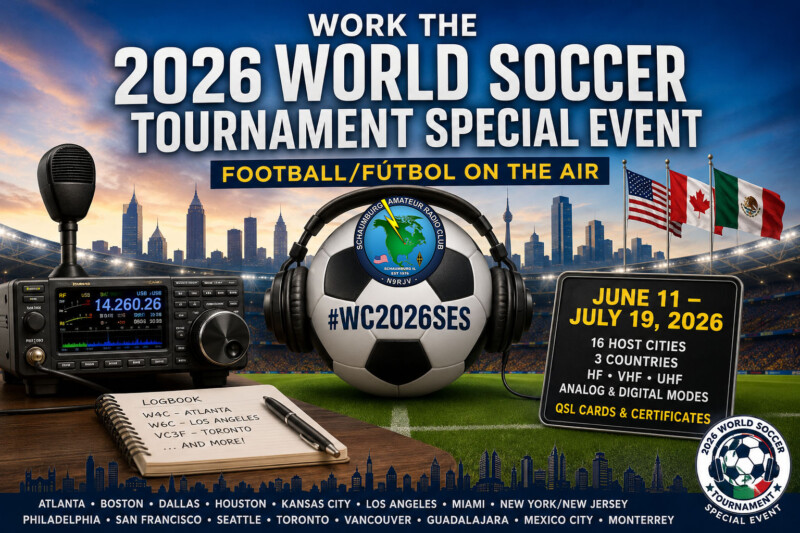
Football/Fútbol on the Air — June 11 through July 19, 2026
Here is a fun operating idea for SARC members: work the 2026 World Soccer Tournament Special Event Stations. Amateur radio operators in the North American host cities are celebrating the tournament by putting special event call signs on the air from the United States, Canada, and Mexico. The event runs from June 11 through July 19, 2026, and stations are operating on HF, VHF, and UHF using analog and digital modes.[1][2]
This is a good event for experienced operators, newer HF operators, digital-mode users, CW operators, and anyone who enjoys chasing special event stations. You do not need to be a soccer expert to participate. Turn on the radio, find an active station, make the contact, log it, and try for more host cities.
Event Snapshot
| Item | Details |
|---|---|
| Event | 2026 World Soccer Tournament Special Event Stations |
| Dates | June 11 – July 19, 2026 |
| Theme | Host-city amateur radio special event stations |
| Countries | United States, Canada, and Mexico |
| Bands and modes | HF, VHF, UHF; analog and digital modes |
| Goal | Work as many host-city stations as possible |
| Extras | QSL cards and certificates are part of the event |
| Hashtag | #wc2026ses |
ARRL’s special-event listing also identifies the event date range and QSL/certificate details for the Dallas entry; use the official event site for the full live schedule and city pages.[3]
The amateur radio event is organized in support of the tournament but is not affiliated with the World Cup itself.[2]
Host City Call Signs to Listen For
The published station list includes special event call signs for the 16 host cities, plus bonus station WC5WC.[5][6] Stadium names below are listed as familiar venue names for operator reference.[8]
| Call Sign | City / Area | Stadium / Note |
|---|---|---|
| W4C | Atlanta | Mercedes-Benz Stadium |
| W1C | Boston | Gillette Stadium |
| W5C/D | Dallas | AT&T Stadium |
| W5C/H | Houston | NRG Stadium |
| K0C | Kansas City | Arrowhead Stadium |
| W6C | Los Angeles | SoFi Stadium |
| K4C | Miami | Hard Rock Stadium |
| W2C | New York / New Jersey | MetLife Stadium |
| WM3PEN | Philadelphia | Lincoln Financial Field |
| W6S | San Francisco | Levi’s Stadium |
| W7C | Seattle | Lumen Field |
| VC3F | Toronto | BMO Field |
| VB7F | Vancouver | BC Place |
| 4A1GDL | Guadalajara | Estadio Akron |
| 4A1CMX | Mexico City | Estadio Azteca |
| 4A1MTY | Monterrey | Estadio BBVA |
| WC5WC | Bonus Station | No stadium |
Station Mix Graph
This graph shows how the 16 host-city stations are distributed across the three host countries. The separate WC5WC bonus station is shown in the station table above.
pie title Host-City Station Mix
    "United States" : 11
    "Canada" : 2
    "Mexico" : 3
This graph separates the regular host-city chase from the bonus station.
pie title Chase Target Count
    "Host-city stations" : 16
    "Bonus station" : 1
Current Note for Chasers
As of July 4, 2026, chasers should pay special attention to the New York / New Jersey credit. The event team reported that W2C contacts counted for the multi-city event only through July 3, and that WC5WC will count toward the achievement certificates through the end of the event on July 19.[7]
Check the official event website before chasing awards, because special event call signs, schedules, and certificate details can change during a large multi-station event.[1]
How Ham Radio Operators Work the Show
The basic operating flow is simple:
Find a station → Listen → Call → Exchange → Log → Confirm → Chase the next city
Operating Flow Diagram
---
config:
  markdownAutoWrap: true
  flowchart:
    wrappingWidth: 220
    useMaxWidth: true
    nodeSpacing: 40
    rankSpacing: 50
---
flowchart TD
    A["`Find a
station`"]

    B["`Listen
first`"]

    C["`Call with your
call sign`"]

    D["`Exchange signal report
and location`"]

    E["`Log the
QSO`"]

    F["`Confirm through a log search
or QSL process`"]

    G["`Chase the
next city`"]

    A --> B
    B --> C
    C --> D
    D --> E
    E --> F
    F --> G
1. Check the schedule
Start at the official event website and look for the city pages, operating schedule, calendar, log search, and QSL information. Host-city teams are active around match days, and activity may move between bands and modes depending on propagation and operator availability.[1][10]
2. Pick a band and mode
For SARC members in Illinois, HF will likely be the easiest way to work many of the stations.[9] Listen on the bands that are open at the time. During the day, try 20, 17, 15, or 10 meters if propagation supports it. In the evening, try 40 and 80 meters. Digital operators should watch common FT8/FT4 watering holes, and CW/SSB operators should watch spotting networks and tune the bands.
3. Listen first
Before calling, copy the station’s call sign, frequency, mode, and instructions. Make sure you know whether the station is operating simplex or split. If there is a pileup, listen to how the operator is taking calls.
4. Call with your call sign
Use your own call sign, or use the club call only if you are authorized to do so. Keep the call short and clear.
Example on SSB:
“Whiskey Charlie Five Whiskey Charlie, this is November Nine Romeo Juliet Victor.”
Or, using your own call:
“Whiskey Charlie Five Whiskey Charlie, this is [your call sign].”
5. Make the exchange
The exchange is usually simple. Give a signal report and your location when requested.
Example:
“You are 59 in Illinois.”
On CW, it may be as simple as:
“5NN IL”
On digital modes, the software will handle much of the exchange, but you still need to verify the correct station, band, mode, and completed QSO.
6. Log the contact
Log each contact carefully. Include:
| Log Item | Example |
|---|---|
| Date | 2026-07-04 |
| Time | UTC time |
| Call sign worked | WC5WC |
| Band | 20m |
| Mode | SSB, CW, FT8, etc. |
| Signal report | 59, 599, or digital report |
| Your station call | Your call sign or authorized club call |
Good logging matters because certificates and QSL confirmations depend on matching records.
7. Confirm and collect
The event promotes QSL cards and certificates, so check the official site for log-search, QSL, and certificate instructions. The event information notes that participants can collect host-city QSL cards and request certificates after the event.[1][4]
Certificate Chase Flow Diagram
---
config:
  markdownAutoWrap: true
  flowchart:
    wrappingWidth: 220
    useMaxWidth: true
    nodeSpacing: 40
    rankSpacing: 50
---
flowchart TD
    A["`Complete each
QSO`"]

    B["`Log the date, UTC time,
call sign, band, and mode`"]

    C["`Check the official
log search`"]

    D{"`Have you contacted
enough host cities?`"}

    E["`Return to the schedule
and chase another station`"]

    F["`Follow the QSL or
certificate instructions`"]

    G["`Save the certificate
and QSL records`"]

    A --> B
    B --> C
    C --> D

    D -->|"No"| E
    E --> A

    D -->|"Yes"| F
    F --> G
8. Share what you find
After you work a station, help other SARC members by sharing useful information: band, mode, approximate signal strength, and whether the station was working simplex or split. This is a great way to help newer operators get on the air and make a successful special event contact.
Suggested SARC Operating Goals
| Operator | Goal |
|---|---|
| Newer HF operator | Work one special event station and practice the exchange |
| Casual operator | Work three to five host cities |
| Digital-mode operator | Chase the stations on FT8 or FT4 |
| CW operator | Try for as many cities as possible on CW |
| HF chaser | Work all available host-city stations |
| Club helper | Spot stations, share band openings, and help others log contacts |
Volunteer Operators Are Part of the Fun
This event also needs operators to help activate the stations. The event information says volunteer operators may operate from their own shack or another preferred location using their own equipment, and that individuals, groups, and clubs are welcome.[1]
Even though Schaumburg is not one of the host cities, SARC members can still participate by chasing the stations, helping others get on the air, spotting active stations, and encouraging members to try a special event contact.
Give It a Try
Special event stations are a great way to build operating confidence. The exchange is short, the stations want to work you, and every contact adds something interesting to your logbook.
Turn on the radio, listen for #wc2026ses activity, and see how many host cities you can work before the event ends on July 19, 2026.
For full details, schedules, log search, QSL information, and certificate updates, visit the official 2026 World Soccer Tournament Special Event website.[1]
Suggested WordPress Details
| Title | Work the 2026 World Soccer Tournament Special Event |
|---|---|
| Category | News or Radio Events |
| Tags | WC2026SES, Special Event Station, HF, SSB, CW, Digital Modes, QSL, SARC, Ham Radio |
| Excerpt | SARC members can work the 2026 World Soccer Tournament Special Event Stations from June 11 through July 19. Listen for host-city call signs across the U.S., Canada, and Mexico, log the contacts, and collect QSL cards and certificates. |
References
- “2026 World Soccer Tournament #wc2026ses.” 2026 World Soccer Tournament Ham Radio Special Event. Accessed July 4, 2026. https://wc2026ses.org/ ↩
- “‘Football on the Air’ Comes to North America.” Amateur Radio Daily, published by Ham Weekly. Published June 9, 2026. Accessed July 4, 2026. https://daily.hamweekly.com/2026/06/football-on-the-air-fifa-world-cup-tournament/ ↩
- “Search for Special Events Stations.” ARRL: The National Association for Amateur Radio. Accessed July 4, 2026. https://www.arrl.org/special_events/search/page%3A1/model%3AEvent ↩
- “Special Event Stations.” ARRL: The National Association for Amateur Radio. Accessed July 4, 2026. https://www.arrl.org/special-event-stations ↩
- “HF Update with ZS4BS.” South African Radio League. Published May 26, 2026. Accessed July 4, 2026. https://mysarl.org.za/hf-update-with-zs4bs-37/ ↩
- “425 DX News Calendar.” 425 DX News. Accessed July 4, 2026. https://www.425dxn.org/index.php?op=wcal ↩
- “Bonus Station WC5WC to Replace W2C for Football Special Event.” Amateur Radio Daily, published by Ham Weekly. Published June 30, 2026. Accessed July 4, 2026. https://daily.hamweekly.com/2026/06/bonus-station-wc5wc-to-replace-w2c-for-football-special-event/ ↩
- “2026 World Cup Cities Map and Venues.” Roadtrips. Accessed July 4, 2026. https://www.roadtrips.com/world-cup/2026-world-cup-packages/venues/ ↩
- “Schaumburg Amateur Radio Club.” Schaumburg Amateur Radio Club. Accessed July 4, 2026. https://www.n9rjv.org/ ↩
- “Log Search.” 2026 World Soccer Tournament Ham Radio Special Event. Accessed July 4, 2026. https://wc2026ses.org/log-search ↩