European Space Agency Proba-3
Here is a fascinating Sun-watching idea for SARC members. The European Space Agency’s Proba-3 mission uses two spacecraft to create artificial solar eclipses in orbit. These long eclipses let scientists study a difficult-to-see part of the Sun’s atmosphere where the solar wind develops and space weather begins.
That matters to amateur radio operators. Activity from the Sun can change Earth’s ionosphere, affect high-frequency propagation, interrupt communications, and sometimes create unusual operating conditions.
Topic Snapshot
| Item | Details |
|---|---|
| Subject | Proba-3 Reveals the Sun’s Inner Corona |
| Mission | European Space Agency Proba-3 |
| Location | The Sun |
| Post idea from | Paul Meyers | KE9EJX |
| Audience | SARC members, visitors, new hams, operators, and volunteers |
| Why it matters | Better observations of the solar wind and the origins of space weather |
| Call to action | Learn more about the Sun’s effects on Earth and amateur radio |
What Proba-3 Accomplished
Proba-3 consists of two spacecraft called the Occulter and the Coronagraph. During an observing period, they fly approximately 150 meters apart and align with the Sun with millimeter-level precision.
The Occulter carries a disk that blocks the bright solar disk. Its shadow falls across the telescope on the Coronagraph spacecraft. This arrangement makes the two spacecraft operate like one enormous scientific instrument.[3]
The artificial eclipse is created for the instrument in space. It is not an eclipse that people can see from Earth.
By April 2026, ESA reported that Proba-3 had completed 57 artificial solar eclipses and collected more than 250 hours of high-resolution observations. Each observing period can last for approximately five hours.[1]
Why the Inner Corona Is Difficult to See
The corona is the Sun’s outer atmosphere. It is extremely hot, but it is also faint compared with the bright solar disk.
A coronagraph is an instrument that blocks direct sunlight so the surrounding corona can be observed. In a conventional coronagraph, scattered and diffracted light can still hide the portion of the corona closest to the Sun.
A natural total solar eclipse provides a better view because the Moon blocks the solar disk from a great distance. However, totality lasts only a few minutes and can be observed from a limited path on Earth.
Proba-3 moves the blocking disk onto a separate spacecraft. The 150-meter separation reduces unwanted light and allows its ASPIICS coronagraph to see the corona as close as approximately 70,000 kilometers above the Sun’s visible surface.
Earlier space instruments could reliably observe the solar disk and the outer corona, but consistent coverage of the region between them was difficult. Proba-3 is helping fill that observational gap.[4]
How the Artificial Eclipse Works
---
config:
  markdownAutoWrap: true
  flowchart:
    wrappingWidth: 220
    useMaxWidth: true
    nodeSpacing: 40
    rankSpacing: 50
---
flowchart TD
    A["`The Sun produces
intense light`"]

    B["`The Occulter spacecraft
blocks the solar disk`"]

    C["`A controlled shadow crosses
the 150-meter separation`"]

    D["`The Coronagraph spacecraft
images the inner corona`"]

    E["`Researchers track plasma
and solar-wind structures`"]

    F["`Results improve models of
the Sun and space weather`"]

    A --> B
    B --> C
    C --> D
    D --> E
    E --> F
The two spacecraft use cameras, laser measurements, radio links, onboard software, and a shadow-position sensor to maintain their alignment. Small thruster corrections keep the coronagraph’s telescope inside the Occulter’s shadow.
What Proba-3 Found
The headline needs one useful clarification. Proba-3 is not exposing a previously unknown solid surface. It is observing the inner corona, which is part of the Sun’s atmosphere above the visible surface.
The important advance is the mission’s ability to repeatedly observe fine motion in this region for hours instead of minutes.
| Reported result | Why it is useful |
|---|---|
| 57 artificial eclipses reported by April 2026 | Scientists can repeat observations instead of waiting for rare natural eclipses. |
| More than 250 hours of high-resolution observations | Long sequences reveal movement that may be missed in individual images. |
| One or two images per minute during observations | The images can be combined into videos that show movement through the corona. |
| Observations down to about 70,000 kilometers above the visible surface | This reaches a previously difficult observational gap in the inner corona. |
| Some tracked plasma structures moved at approximately 250–500 kilometers per second | These structures were moving roughly three to four times faster than expected in that region. |
The first published study tracked small structures moving through streamers and pseudostreamers. Streamers are bright extensions of plasma shaped by the Sun’s magnetic field.
Researchers observed a wide range of speeds, accelerations, and directions. Some structures moved outward while others appeared to move inward. The results show that the region where the slow solar wind forms is more complicated and dynamic than a single smooth stream.[2]
These are early results. They do not settle every question about solar-wind acceleration, coronal heating, or coronal mass ejections. ESA also noted that much of the collected Proba-3 data still needed to be analyzed when the first results were announced.
Why This Matters to Amateur Radio
The solar wind is a continuing flow of charged particles, or plasma, moving outward from the Sun. A coronal mass ejection, usually shortened to CME, is a much larger release of plasma and magnetic field from the corona.
Not every solar event is directed toward Earth. When solar material and its magnetic field do interact with Earth, they can disturb the magnetosphere and ionosphere.
The ionosphere is a group of electrically charged regions high in Earth’s atmosphere. Amateur radio operators use these regions to support long-distance high-frequency communication.
HF means high frequency, generally 3–30 MHz. Changes in ionospheric density and structure can improve a path, weaken it, move the usable frequency range, or block an HF signal. Solar X-rays can quickly increase absorption in the ionosphere’s D region and cause a radio blackout on the sunlit side of Earth.[5]
CMEs and changes in the solar wind can arrive later and produce geomagnetic disturbances. Space-weather forecasters study a CME’s speed, size, direction, and magnetic field to estimate whether it may affect Earth.[6]
Proba-3 is a research mission, not a direct amateur-radio propagation forecast. Its value comes from improving our understanding of how solar-wind structures and eruptions develop close to the Sun.
A Simple Sun-to-Radio Connection
</ tr>
| Solar or space-weather condition | Possible radio observation | Operator response |
|---|---|---|
| Increased extreme-ultraviolet activity | Changes in ionization and usable HF frequencies | Compare several bands and note the time of day. |
| Strong solar flare | Rapid HF absorption or a dayside radio blackout | Check NOAA flare and D-region products before changing equipment. |
| Earth-directed CME | Possible geomagnetic disturbance after the material arrives | Watch official forecasts and record changing band conditions. |
| Disturbed geomagnetic field | Unstable polar paths, fading, noise, or unusual propagation | Try another band, direction, time, or operating mode. |
Watch the Proba-3 Video
How to Participate
- Watch the video. Note how the two spacecraft replace the Moon and an Earth-based telescope in the eclipse geometry.
- Check official space-weather information. Visit the NOAA Space Weather Prediction Center before an HF operating session.
- Record your conditions. Write down the date, local and UTC time, band, mode, signal reports, noise level, and any unusual fading.
- Check the F10.7 solar flux. This 2,800 MHz measurement is a useful indicator of solar activity and is widely used in space-weather work.[7]
- Compare more than one session. A single good or poor contact does not prove that space weather caused the result.
- Share what you learned. Turn your notes into a short SARC presentation, website article, or club discussion.
Suggested SARC Goals
| Member type | Suggested goal | Practical activity |
|---|---|---|
| New ham | Understand the Sun–ionosphere–radio connection | Explain the connection in three simple steps to another member. |
| HF operator | Connect forecasts with real operating conditions | Keep a short propagation log for three operating sessions. |
| Digital-mode operator | Compare band conditions objectively | Record band, time, decode activity, and official space-weather conditions. |
| VHF or UHF operator | Learn how disturbed conditions can differ from everyday propagation | Compare beacon, digital-mode, or weak-signal observations with official reports. |
| Builder or experimenter | Study precision sensing and control | Prepare a short explanation of how cameras, lasers, radio links, and thrusters maintain formation. |
| Presenter or writer | Help other members understand space weather | Create a five-minute presentation or a short article for the SARC website. |
Give It a Try
Watch the Proba-3 video, then check the current space-weather information before your next operating session. See whether the conditions you hear on the air match what the official data suggests.
You do not need to be a solar physicist to take part. A simple log and a few careful observations can help connect solar research with everyday amateur radio.
Visit N9RJV.org for more SARC activities, technical articles, and opportunities to learn with other amateur radio operators.
Suggested WordPress Details
| Title | Proba-3 Reveals the Sun’s Inner Corona |
|---|---|
| Category | Space Weather |
| Tags | Proba-3, Sun, solar corona, solar wind, space weather, HF propagation, ESA, amateur radio |
| Excerpt | Two spacecraft are creating artificial eclipses so scientists can track motion in the Sun’s inner corona and improve our understanding of space weather. |
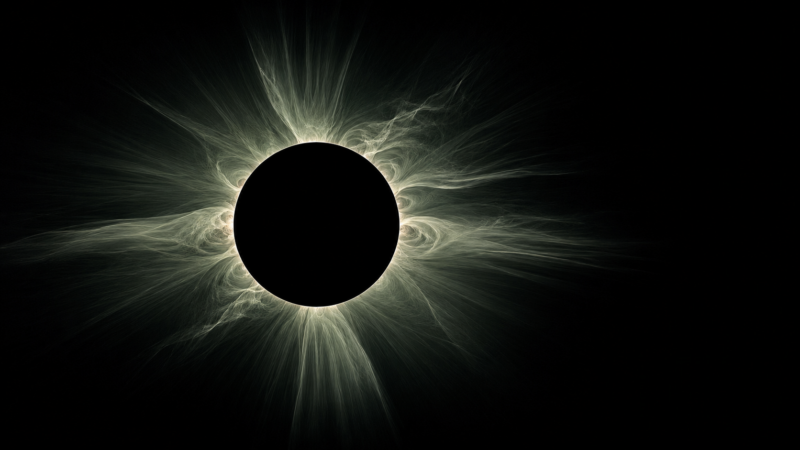
| Suggested Image | Image: A 16:9 ESA Proba-3 ASPIICS image showing the inner solar corona during an artificial eclipse. Alt text: Proba-3 artificial eclipse revealing streamers in the Sun’s inner corona. Caption: Proba-3 uses two precisely aligned spacecraft to block the bright solar disk and observe the faint inner corona. Credit the image according to the requirements listed by its original source. |
| Call to Action | Watch the Proba-3 video, check official space-weather information, and compare it with conditions during your next amateur-radio operating session. |
References
- European Space Agency. “First Proba-3 Science: Surprisingly Speedy Solar Wind.” Published April 13, 2026. Accessed August 8, 2026.
https://www.esa.int/Science_Exploration/Space_Science/First_Proba-3_science_surprisingly_speedy_solar_wind
↩ - Zhukov, A. N., et al. “Ubiquitous Small-scale Dynamics in the Slow Solar Wind Formation Region Observed by Proba-3/ASPIICS.” The Astrophysical Journal Letters, Volume 999, Number 2, L41. American Astronomical Society, March 2026. Accessed August 8, 2026.
https://doi.org/10.3847/2041-8213/ae469b
↩ - European Space Agency. “Proba-3 Achieves Precise Formation Flying.” Published May 8, 2025. Accessed August 8, 2026.
https://www.esa.int/Enabling_Support/Space_Engineering_Technology/Proba-3_achieves_precise_formation_flying
↩ - European Space Agency. “Proba-3 Fills the Solar Observation Gap.” Published December 17, 2025. Accessed August 8, 2026.
https://www.esa.int/Enabling_Support/Space_Engineering_Technology/Proba-3_fills_the_solar_observation_gap
↩ - NOAA/National Weather Service Space Weather Prediction Center. “HF Radio Communications.” Accessed August 8, 2026.
https://www.spaceweather.gov/impacts/hf-radio-communications
↩ - NOAA/National Weather Service Space Weather Prediction Center. “Coronal Mass Ejections.” Accessed August 8, 2026.
https://www.spaceweather.gov/phenomena/coronal-mass-ejections
↩ - NOAA/National Weather Service Space Weather Prediction Center. “F10.7 cm Radio Emissions.” Accessed August 8, 2026.
https://www.spaceweather.gov/phenomena/f107-cm-radio-emissions
↩ - Astrum. “We’ve Seen the Sun’s Inner Corona for the First Time.” YouTube. Accessed August 8, 2026.
https://youtu.be/fv5lJjR6DmQ
↩