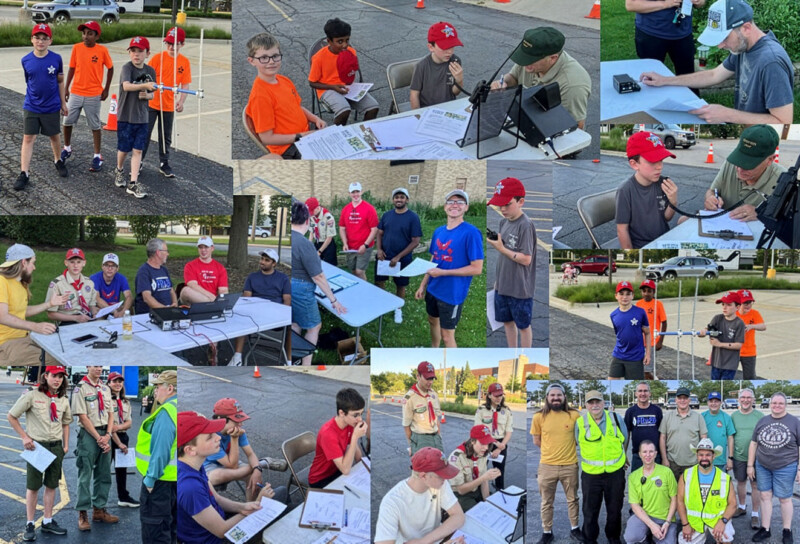
Here is a valuable public service opportunity for SARC members. Schaumburg Septemberfest returns over Labor Day weekend, and amateur radio volunteers are needed to help support event communication.
SARC members can now review the available assignments and volunteer through the club’s member-only Septemberfest sign-up page. Enter an approved amateur radio call sign to open the assignment sheet.[1]
Event Snapshot
Schaumburg Septemberfest 2026 details
Detail
Information
Event
Schaumburg Septemberfest
Dates
Saturday, September 5, through Monday, September 7, 2026
Saturday hours
10:00 a.m. to 10:00 p.m.
Sunday hours
10:00 a.m. to 10:00 p.m.
Monday hours
10:00 a.m. to 9:00 p.m.
Location
Al Larson Prairie Center for the Arts and Municipal Center grounds
Address
201 Schaumburg Court, Schaumburg, IL 60193
Admission
Free
SARC activity
Public service communication support
Volunteer access
SARC member access and an approved amateur radio call sign are required
Septemberfest schedules, maps, access points, and volunteer assignments may change. Volunteers should check the SARC assignment page and official Village of Schaumburg information before reporting.[2]
Why SARC Supports Septemberfest
Septemberfest is the Village of Schaumburg’s flagship community event. The three-day festival historically attracts more than 100,000 visitors and includes entertainment, food, carnival rides, arts and crafts, bingo, a drone show, and the Labor Day parade.
A large public event creates many routine communication needs. Organizers may need updates from distant locations, information about changing conditions, requests for supplies, or confirmation that an assigned area is operating normally.
SARC volunteers help connect those locations through organized amateur radio communication. This gives event officials another dependable way to exchange information across a large and busy festival site.[3]
Amateur radio volunteers do not replace police officers, firefighters, medical personnel, or Village staff. Our role is to observe, communicate clearly, and follow the event’s established command structure.
The assignment sheet is restricted to approved SARC members. Enter your amateur radio call sign to continue. Call-sign entry is not case-sensitive.
Review the Available Assignments
Read the date, time, location, and requested number of volunteers for each assignment. Select a position only when you can cover the complete scheduled period.
The sign-up page reflects current availability. An assignment may close when the requested number of volunteers has been reached.
Complete Your Information
Provide the requested name, call sign, email address, and cell phone number. The cell phone number gives event coordinators a backup way to contact you before or during the assignment.
An emergency-contact telephone number may also be provided. Review your information carefully before submitting it.
Watch for Instructions
After signing up, watch your email for reporting instructions, radio programming information, parking directions, credentials, or required Village volunteer registration.
Do not rely on an assignment or radio plan from a previous year. Municipal Center construction will affect the 2026 festival layout, even though Septemberfest remains on the usual Prairie Center and Municipal Center grounds.[4]
Volunteer Sign-Up Flow
---
config:
  markdownAutoWrap: true
  flowchart:
    wrappingWidth: 220
    useMaxWidth: true
    nodeSpacing: 40
    rankSpacing: 50
---
flowchart TD
    A["`Open the SARC
volunteer page`"]

    B["`Enter an approved
call sign`"]

    C["`Review open
assignments`"]

    D["`Select an available
assignment`"]

    E["`Confirm your contact
information`"]

    F["`Submit the
volunteer form`"]

    G["`Watch for coordinator
instructions`"]

    H["`Report prepared
and on time`"]

    A --> B
    B --> C
    C --> D
    D --> E
    E --> F
    F --> G
    G --> H
What SARC Volunteers May Do
Exact duties depend on the assignment and the directions provided by the event coordinator. Typical public service communication work may include:
Maintaining radio contact with Net Control
Providing status reports from an assigned position
Relaying requests or observations accurately
Monitoring activity near an assigned area
Helping event staff locate the correct resource
Recording important traffic or assignment changes
Remaining at the assigned position until properly relieved
If a visitor asks a question, be friendly and helpful. If you do not know the answer, direct the visitor to the appropriate Village employee, police officer, information point, or event official.
What to Bring
Suggested Septemberfest volunteer checklist
Item
Why It Helps
Programmed radio
Provides access to the assigned primary and backup channels
Spare battery
Helps keep the station operating through the complete assignment
Headset or earpiece
Makes messages easier to hear in a noisy festival environment
Charged cell phone
Provides backup contact with the coordinator
Notebook and pens
Supports accurate logging of messages and assignment changes
Helps maintain hydration during an outdoor assignment
Comfortable footwear
Some assignments may require standing or walking
Assignment instructions
Provides reporting time, location, contact information, and operating guidance
Bring only equipment that you can carry and manage safely. Keep cables, bags, and radio accessories out of walkways.
Good Radio Practice at a Busy Event
Listen before transmitting.
Use your assigned tactical identifier or call sign as directed.
Keep routine messages short and specific.
Repeat important names, locations, or numbers when necessary.
Do not add guesses or personal opinions to a report.
Acknowledge instructions so Net Control knows they were received.
Report urgent traffic promptly and follow Net Control’s direction.
Protect personal and sensitive information.
Notify Net Control before leaving an assigned position.
Complete any required log or after-action information.
A Strong Record of Service
SARC has a demonstrated record of supporting Schaumburg Septemberfest.
In 2024, 13 volunteers contributed more than 93 hours, including planning, radio testing, and event operations. In 2025, 26 volunteers contributed more than 80 service hours and were recognized for serving as extra eyes and ears for Village personnel.[5][6]
Recent SARC Septemberfest public service participation
Year
Volunteers
Reported Service
2024
13
More than 93 hours, including preparation and event operations
2025
26
More than 80 service hours
Suggested SARC Goals
Suggested goals for Septemberfest volunteers
Member Type
Suggested Goal
First-time volunteer
Choose a manageable assignment, attend any briefing, and learn the event communication structure.
New Technician
Practice clear VHF or UHF communication while working under the direction of Net Control.
Experienced operator
Take an assignment that requires steady communication and help newer volunteers prepare.
Net-control operator
Maintain an organized log, acknowledge each station, and keep radio traffic moving efficiently.
Portable operator
Test batteries, audio accessories, and radio programming before the event.
SARC mentor
Invite a newer member to participate and explain public service operating practices.
Give It a Try
Septemberfest is one of SARC’s most visible public service activities. It allows members to practice useful communication skills while helping the community we serve.
If you are available over Labor Day weekend, review the open assignments and select a position that fits your schedule and experience. First-time volunteers are welcome, and experienced members can make the event even stronger by helping others prepare.
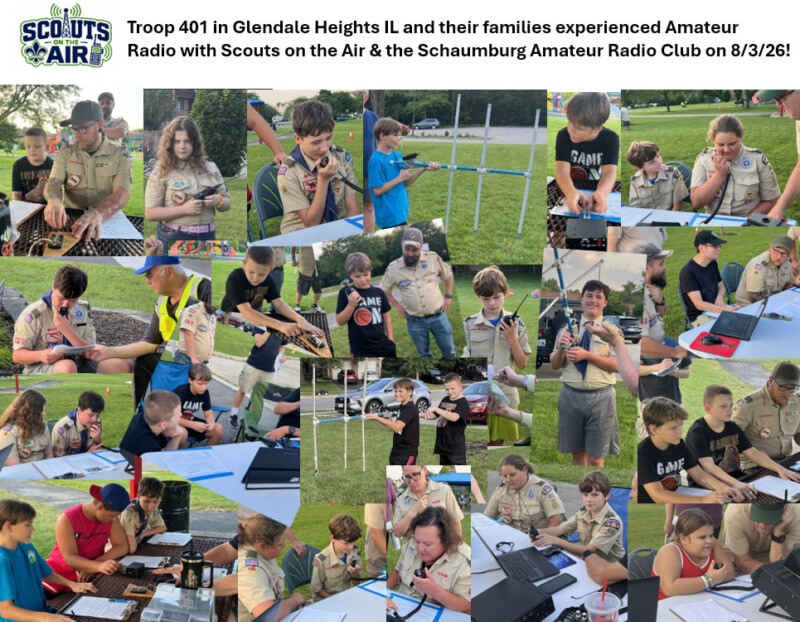
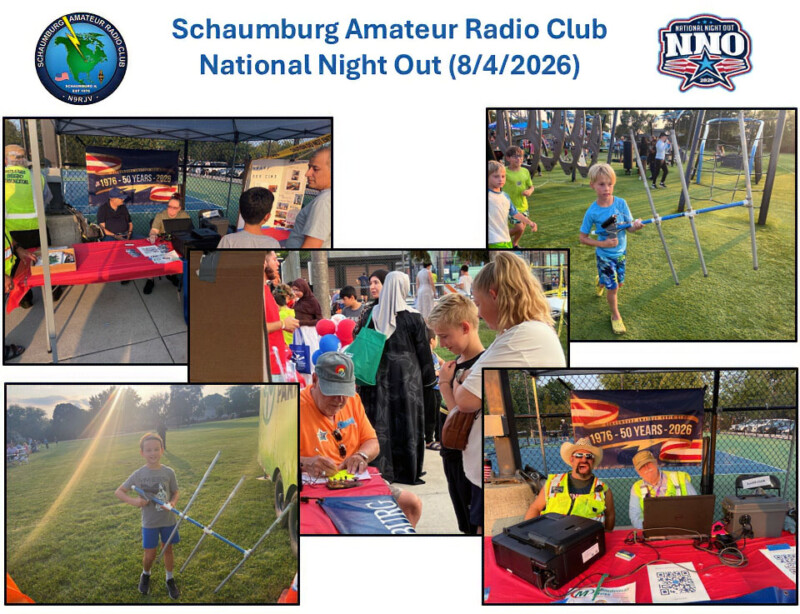
Thanks to Bill (W9WEM), Dennis (KD9HIK), Howard (KD9WSV), Leo (N9NBH), Paul (KD9FMN), Jim (N9XP), Brenda/Bill (N9MHT) who donated their time with the scouts and their families last night during a beautiful evening. Enjoy this collection of photos! Our upcoming events are on 8/18 (YRC) and 9/1 (SARC) with more details available here <http://www.AmateurRadioEvents.com/scoutsontheair>.
SARC and the Scouts on the Air program are partnering to put a Glendale Heights scout troop on the air from 6:50 pm to 7:50 pm CDT on Monday, August 3rd. In addition to learning CW, exploring beacon hunting, and practicing emergency communications, the scouts and their leaders & families will also be calling CQ on HF SSB on 14.328 and FT8 on 21.074.
Details are also posted at Scouts on the Air and will be updated, if needed, before and during the event.
Mark your calendar to get on the air to give our guests a QSO, a smile, and a lasting memory.
For ages 12-14 in Glendale Heights, IL (22 miles W of Chicago in EN51xv)
SARC and the Scouts on the Air program are partnering to put a Schaumburg scout troop on the air from 7:20 pm to 8:20 pm CDT on Tuesday, September 1st.
In addition to learning CW, exploring beacon hunting, and practicing emergency communications, the scouts and their leaders & families will also be calling CQ on HF SSB and FT8, exploring DMR, and seeking QSOs on a local repeater.
Details will be posted and updated in August at Scouts on the Air. Mark your calendar to get on the air to give our guests a QSO, a smile, and a lasting memory.
For ages 10-18 in Schaumburg, IL (23 miles NW of Chicago in EN52xa)
Here is a fun community event for SARC members, families, and anyone curious about amateur radio. The Schaumburg Amateur Radio Club will have a booth at National Night Out on Tuesday, August 4, 2026, at Meineke Recreation Center.
National Night Out brings residents, police officers, neighborhood groups, and local organizations together in a friendly setting. It is a good opportunity to meet the people who serve our community while learning more about the organizations active in Schaumburg.[1]
Visit the SARC booth at Schaumburg National Night Out and discover how you can get started in amateur radio.
Event Snapshot
National Night Out 2026 event details
Detail
Information
Event
National Night Out
Date
Tuesday, August 4, 2026
Time
6:00 p.m. to 8:00 p.m.
Location
Meineke Recreation Center and Meineke Park
Address
220 E. Weathersfield Way, Schaumburg, IL 60193
Admission
Free; no registration is required
Ages
All ages
SARC participation
Visit the Schaumburg Amateur Radio Club booth
Event sponsor
Schaumburg Bank & Trust
A Community Evening at Meineke Park
National Night Out is an annual community-building campaign that encourages positive connections between residents, law enforcement officers, and neighborhood organizations.[2]
The Schaumburg event will include games, contests, giveaways, and opportunities to meet local police officers and community organizations. Food will also be available for purchase.[3]
During the final hour, Meineke Pool will offer free open swim. Anyone planning to swim should check the Schaumburg Park District event page before attending in case pool rules, schedules, or event details change.
Meet the SARC Booth Team
SARC members will be available throughout the event to welcome visitors and answer questions about amateur radio.
SARC members scheduled to staff the booth
SARC Member
Call Sign
Howard Mitchell
KD9WSV
Kirk Musselman
K9MSG
Robert Benwitz
N9JAX
If you have heard the term “ham radio” but are not sure what it means, this is a good time to ask. Amateur radio is a licensed radio service used for communication, technical learning, experimentation, public service, and recreation.
You do not need any radio experience to visit the booth. New operators, experienced hams, families, and curious visitors are all welcome.
Why SARC Participates
National Night Out gives SARC an opportunity to meet people outside a regular club meeting. It also helps residents learn that amateur radio remains an active hobby with practical community connections.
Visitors can ask about getting an amateur radio license, joining the club, attending a SARC activity, or taking the first steps toward getting on the air.
Current operators are welcome to stop by, introduce themselves, and share what parts of amateur radio they enjoy. A short conversation can make the hobby feel much more approachable to someone who is just getting started.
How to Participate
Visit the Event
Come to Meineke Recreation Center between 6:00 p.m. and 8:00 p.m. Admission is free, and the event is open to all ages.
Stop at the SARC Booth
Look for the Schaumburg Amateur Radio Club booth. Meet the SARC volunteers, ask questions, and learn how amateur radio can connect people across town or around the world.
Bring a Friend or Family Member
National Night Out is designed as a community event. Bringing someone who has never seen amateur radio is a simple way to introduce the hobby.
Explore the Rest of the Event
Allow time to meet police officers and neighborhood organizations, enjoy the activities, and visit the other community booths. Families interested in the free open swim should bring the appropriate swim gear and review current pool information before leaving home.
How the Evening Works
---
config:
  markdownAutoWrap: true
  flowchart:
    wrappingWidth: 220
    useMaxWidth: true
    nodeSpacing: 40
    rankSpacing: 50
---
flowchart TD
    A["`Arrive at Meineke
Recreation Center`"]

    B["`Explore National
Night Out`"]

    C["`Meet police and
community organizations`"]

    D["`Visit the
SARC booth`"]

    E["`Ask about
amateur radio`"]

    F["`Learn how to
get involved`"]

    G["`Enjoy activities
and open swim`"]

    A --> B

    B --> C
    B --> D
    B --> G

    D --> E
    E --> F
What to Bring
Your family, friends, or neighbors
Questions about amateur radio or SARC
Your call sign if you are already a licensed operator
Swimwear and other pool items if you plan to use the free open swim
A way to pay if you would like to purchase food
Weather-appropriate clothing for an outdoor community event
Event arrangements can change. Check the official Schaumburg Park District event page before attending for the latest information.
Suggested SARC Goals
Simple goals for different visitors and club members
Participant
Suggested Goal
Someone new to amateur radio
Visit the SARC booth and ask what is required to earn an amateur radio license.
Newly licensed operator
Meet local operators and ask about SARC nets, activities, and opportunities to get on the air.
Experienced operator
Introduce yourself and help make newer visitors feel welcome.
SARC member
Stop by the booth, greet the volunteer team, and invite a friend to learn about the club.
Parent or family member
Ask how amateur radio can support technical learning, communication skills, and family activities.
Community visitor
Meet local organizations and learn how residents can become more connected with their community.
Give It a Try
National Night Out is an easy way to spend a summer evening with neighbors while learning more about Schaumburg’s community organizations.
Please stop at the SARC booth and say hello to Howard Mitchell, KD9WSV; Kirk Musselman, K9MSG; Robert Benwitz, N9JAX; and Paul Meyers, KE9EJX. Whether you are already licensed or simply wondering what amateur radio is all about, we will be glad to meet you.
We hope to see you at Meineke Recreation Center on Tuesday, August 4.
Prepared for the Schaumburg Amateur Radio Club (SARC), N9RJV by Pau Meyers KE9EJX
Updated
Introduction:
A Southern Illinois Hazard with Chicagoland Consequences
The New Madrid Seismic Zone is centered in northeastern Arkansas, southeastern Missouri, western Tennessee, and western Kentucky. Schaumburg and Chicago are roughly 380 straight-line miles from New Madrid, Missouri, so the northwest suburbs are not expected to experience the same effects as communities close to the source. That distance, however, does not make the hazard irrelevant.
Central and eastern U.S. crust can carry noticeable shaking over broad areas, while Illinois depends on statewide transportation, fuel, power, health-care, public-safety, and supply networks. Chicagoland could face locally felt shaking and inspections, followed by logistics and mutual-aid demands supporting harder-hit areas. Cellular networks may be congested even where towers survive, and damaged fiber or commercial power can isolate individual facilities.
Trained radio amateurs can fill a defined communications gap when requested. They do not replace 911, dispatch, emergency managers, or agency professionals. Their value is disciplined operation within ICS: following the channel plan, passing exact messages, documenting traffic, conserving power, and sustaining assigned positions.
Event Snapshot
New Madrid earthquake planning snapshot for SARC and Chicagoland
Question
Planning answer
What is the hazard?
An active central U.S. seismic zone capable of damaging earthquakes. The U.S. Geological Survey estimates a 25–40 percent chance of a magnitude 6.0 or greater event in the zone during the next 50 years, and a 7–10 percent chance of a sequence comparable to 1811–1812. Those probabilities do not predict a date or the shaking at a particular address.[1]
Where would effects be greatest?
The most severe direct effects would be expected nearer the New Madrid and Wabash Valley seismic zones, especially where water-saturated, loose sediments can amplify shaking or liquefy.
What could happen near Chicago?
Felt shaking; inspection or temporary closure of buildings, bridges, rail lines, utilities, and industrial facilities; communications congestion; supply disruption; reception of evacuees; and requests for personnel or equipment elsewhere in Illinois.
Who leads response?
Local incident command and emergency operations centers lead locally. County and state emergency management coordinate additional resources; federal assistance supports state and local operations when requested.
What can hams do?
Staff assigned communications positions, support shelters or staging areas, pass resource and situation messages, operate voice or data links, and maintain communications logs—only under a recognized organization or served agency.
How long should households prepare?
Illinois promotes a minimum of two weeks of household readiness for a major earthquake. A 72-hour radio deployment kit is a useful module, but it is not the complete household plan.[2]
Understanding the New Madrid Seismic Zone
The NMSZ is not one visible crack. Earthquake patterns outline buried fault branches beneath river sediments and an ancient crustal weakness called the Reelfoot Rift. Instruments have recorded thousands of small to moderate events since the 1970s, while buried sand blows preserve evidence of older earthquakes.[1]
The historic sequence began December 16, 1811. Three principal earthquakes—currently estimated near magnitude 7.5, 7.3, and 7.5—were followed by months of aftershocks. They damaged Mississippi River settlements and caused landslides, ground failure, and widespread liquefaction.[3]
History is not a countdown clock. USGS stresses that probability estimates cannot identify the date, epicenter, or shaking at an individual address. Hazard maps, site information, building assessment, and realistic exercises are better planning tools.[1]
New Madrid and Wabash Valley Are Different Hazards
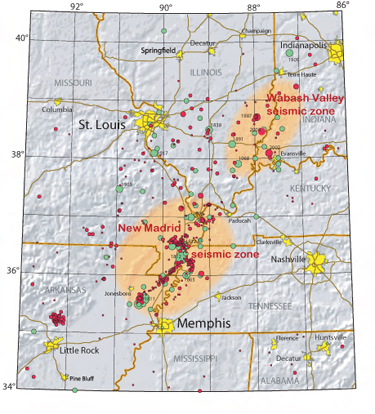
Illinois planners consider both the NMSZ and the Wabash Valley Seismic Zone along southeastern Illinois and southwestern Indiana. Historic Illinois earthquakes in 1968, 1987, and 2008 occurred in the broader Illinois Basin/Wabash region rather than in the central New Madrid trend. The distinction matters: “New Madrid earthquake” is often used casually for any central U.S. quake, but response plans must start with the actual epicenter, magnitude, depth, soil conditions, and observed damage.
Why Chicago and Schaumburg Are Affected
1. Central U.S. Shaking Travels Farther
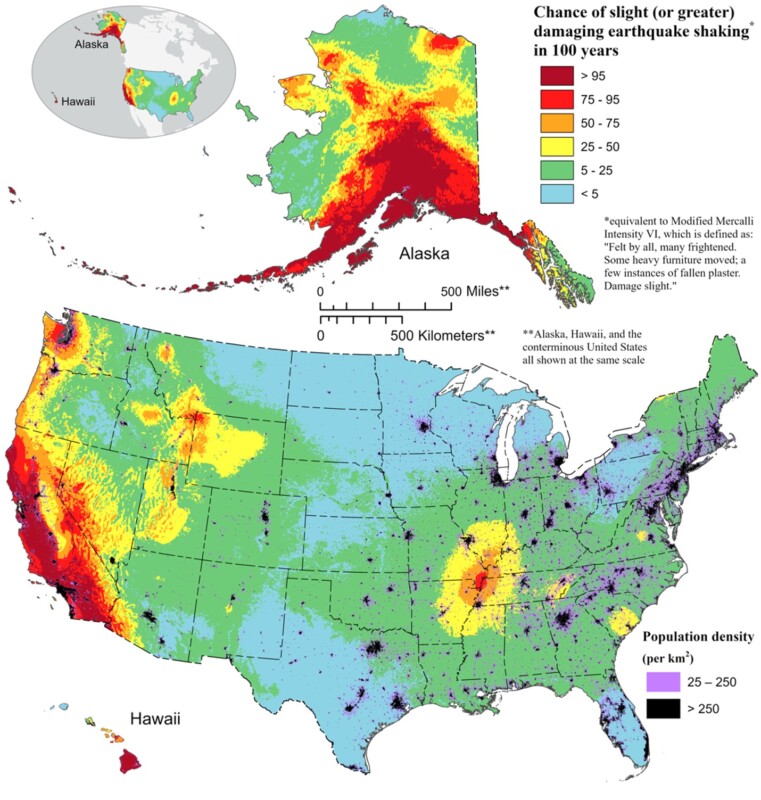
Central and eastern U.S. crust lets seismic energy remain noticeable over a broader area than in much of the West. Chicago would not experience New Madrid-level effects, but a strong event could be felt in northern Illinois and prompt precautionary inspections. The USGS national model shows the highest central U.S. hazard around New Madrid and lower, nonzero hazard across Illinois.[4]
2. Local Ground and Buildings Matter
Magnitude and distance are only part of the risk. Loose floodplain sediments can amplify motion compared with glacial till or bedrock, and every site combines different geologic and structural factors.[5] Chicagoland’s fill, river corridors, older masonry, high-rises, and facilities built under different codes require site-specific assessment.
3. Lifelines Connect the Whole State
A southern Illinois earthquake could disrupt highways, bridges, rail, pipelines, transmission, river crossings, and communications routes. Schaumburg might see shortages, patient transfers, outbound mutual aid, or local shelters and reception centers. Communications support may therefore be needed far from the epicenter.
4. Communications Can Fail Selectively
A working phone system does not guarantee every path. Fiber damage, a powerless remote site, or cellular congestion can isolate one facility. Amateur Radio is most useful when it fills that specific gap with the simplest reliable method and a written message process.
Illinois Earthquake History: Planning Lessons
Selected earthquakes relevant to Illinois preparedness
Date or period
Event
Planning lesson
1811–1812
Three very large New Madrid mainshocks, each approximately magnitude 7.3–7.5 by current USGS estimates, plus a long aftershock sequence.
Large central U.S. earthquakes can produce widespread shaking, liquefaction, ground failure, and prolonged operational demands.
November 9, 1968
A damaging southern Illinois earthquake, commonly cataloged around magnitude 5.3–5.5 depending on magnitude scale and study.
Moderate Illinois earthquakes can be felt across many states and damage vulnerable chimneys, masonry, and contents.[6]
June 10, 1987
A magnitude 5-class earthquake near Olney in southeastern Illinois.
The Illinois Basin/Wabash region remains capable of widely felt events even outside the central New Madrid trend.[7]
April 18, 2008
USGS catalog: magnitude 5.2, about 7 km north-northeast of Bellmont, Illinois.
Instrumental catalogs and magnitudes may be revised; use current official event data rather than repeating a rounded headline number.[8]
Ongoing
Illinois averages about five earthquakes per year, mainly in southern Illinois; most are magnitude 2–4.
Routine small earthquakes are reminders to maintain plans, but they do not by themselves signal that a large event is imminent.[5]
Maps: Putting Schaumburg, Illinois, and New Madrid in Context
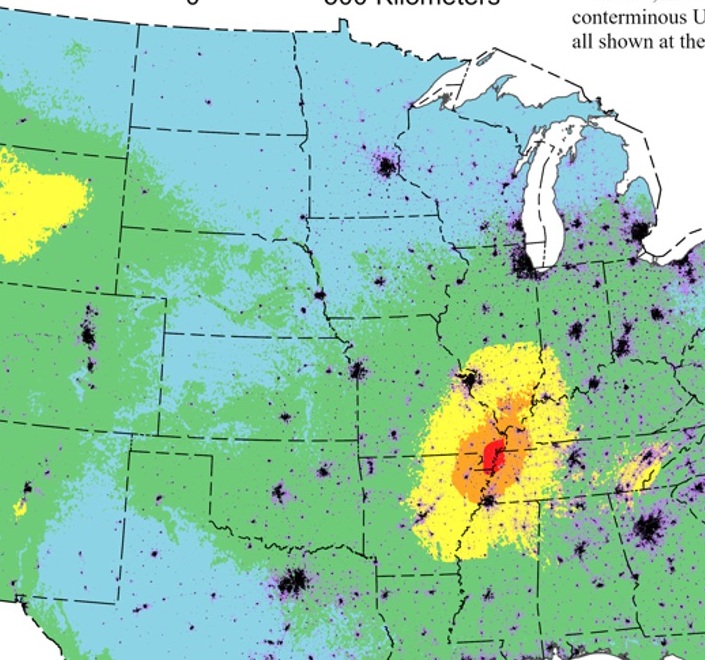
USGS central U.S. seismicity map. The New Madrid trend lies south and southwest of Illinois; the Wabash Valley trend reaches southeastern Illinois and southwestern Indiana. Source: U.S. Geological Survey, public domain.[9]Midwest extract from the 2023 USGS National Seismic Hazard Model map. It depicts the chance of at least slight damaging shaking over 100 years; it is a long-term hazard map, not a forecast for a specific earthquake. See the full map below for the legend and national context.[4]Full 2023 USGS National Seismic Hazard Model public-domain map.[4]
How Emergency Response Scales from Schaumburg to the Nation
Response begins locally. Schaumburg’s EOC coordinates village information, continuity, and requests for assistance.[10] Cook County EMRS integrates resources across 134 municipalities and more than five million residents.[11]
Illinois can coordinate statewide assets, including MABAS fire, EMS, and specialized teams.[12] CUSEC links eight central states through a catastrophic-planning project built around a magnitude 7.7 scenario.[13] FEMA supports state and local operations when requested; it does not replace local command.
Response partners and likely communications needs
Level or organization
Primary role
Possible auxiliary-communications support
Incident Command
Directs tactical operations at the incident.
Assigned field, staging, shelter, or logistics links.
Schaumburg EOC
Coordinates village strategy, continuity, information, and resource requests.
Radio position, message desk, backup path to an assigned facility.
Cook County EMRS
Coordinates regional information and resources among municipalities.
County net, liaison, or data-message support when requested.
IEMA-OHS and mutual aid
Coordinates state resources, situation reporting, and requests for outside assistance.
State ARES/AUXCOMM assignments, deployable teams, or relief operators.
CUSEC and FEMA
Support multistate planning and federal resource coordination.
Long-haul communications, documentation, and interoperable support under established plans.
---
config:
  markdownAutoWrap: true
  flowchart:
    wrappingWidth: 220
    useMaxWidth: true
    nodeSpacing: 40
    rankSpacing: 50
---
flowchart TD
    A["`Earthquake and
local reports`"]

    B["`On-scene
Incident Command`"]

    C["`Schaumburg Emergency
Operations Center`"]

    D["`Cook County
EMRS`"]

    E["`IEMA-OHS and
State EOC`"]

    F["`CUSEC interstate
coordination`"]

    G["`FEMA and
federal assistance`"]

    H["`ARES, RACES, AUXCOMM,
and SARC volunteers`"]

    A --> B
    A --> C

    B <--> C

    C --> D
    D --> E

    E --> F
    E --> G

    H -->|"Only when requested<br/>and assigned"| B
    H -->|"Assigned communications<br/>positions"| C
    H -->|"Through authorized<br/>plans"| D
The First 72 Hours—and the Two Weeks Beyond
The first operational period is likely to be confused: shaking reports arrive, facilities inspect for damage, aftershocks occur, and officials try to establish a common operating picture. By 12–24 hours, the response becomes more structured: shelters, staging areas, medical transfers, route status, and resource requests generate formal traffic. At 24–72 hours, relief staffing, fuel, batteries, food, sanitation, and documentation become central. Illinois’s two-week readiness message recognizes that transportation and utility restoration may take much longer than three days.[2]
timeline
    title Communications priorities after a major regional earthquake
    0 to 6 hours : Personal safety and accountability
                 : Damage and lifeline reports
                 : Establish incident and EOC communications
    6 to 24 hours : Shelter and hospital links
                  : Resource requests and route status
                  : Formal message logging
    24 to 72 hours : Shift relief and battery/fuel resupply
                   : Situation reports and mutual aid
                   : Alternate and long-haul paths
    Day 4 to 14 : Sustained staffing and welfare traffic
                : Recovery coordination
                : Documentation and demobilization
Where Amateur Radio Fits—and Where It Does Not
ARES consists of licensed amateurs who register qualifications and equipment with local leadership; local training may be required.[14] RACES is an FCC-regulated civil-defense service, while AUXCOMM integrates trained auxiliary communicators into an ICS Communications Unit. The served agency determines whether, where, and how volunteers are used.
SARC policy is equally clear: a served agency initiates EMCOMM engagement, and a SARC coordinator serves as liaison.[15] Professional operators do not freelance, arrive uninvited, transmit unnecessary sensitive information, or substitute personal preferences for the incident plan.
Amateur Radio organizations and relationships
Term
What it means
For a SARC member
SARC EMCOMM
Club training and served-agency support coordinated under SARC policy.
Practice nets, portable operations, message handling, and requested local support.
ARES
ARRL field organization of registered licensed volunteers.
Register locally, complete required training, participate in nets and exercises.
RACES
Radio service governed by FCC Part 97.407 and directed by a civil-defense organization.
Follow the authorizing government organization’s enrollment and activation rules.[16]
AUXCOMM
ICS-based integration of auxiliary communicators into the Communications Unit.
Pursue prerequisite ICS training and agency affiliation before advanced coursework.[17]
ARES-Style Activation Procedure
Protect life and become available. Drop, cover, and hold during shaking. Check family, home, medications, and immediate hazards. Do not become another person needing rescue.
Monitor official and organizational channels. Use public alerts, local government information, the designated ARES/RACES method, and SARC communications. Rumors and scanner traffic are not tasking orders.
Report availability, not deployment. Give your call sign, location, capabilities, power endurance, and limitations. Illinois ARES guidance states: consider deployment only if requested; do not self-deploy.[18]
Receive an assignment and safety brief. Know the reporting location, contact, operational period, net, channel, backup, equipment, personal-sustainment expectation, and demobilization process.
Check in and use the plan. Work the assigned net and ICS-205 channel. Use the minimum power necessary. Do not scan or casually change a radio needed for a critical channel.
Pass exact traffic. Use plain language. For formal messages, copy the originator’s meaning and wording accurately, confirm numbers and names, and obtain missing fields before transmission.
Document. Record activity on ICS-214 and message traffic on ICS-309 or the form specified by the served agency. Illinois ARES identifies ICS-213 as the principal formal-message template and requires messages to be logged.[19]
Relieve and demobilize correctly. Brief the next operator, transfer logs, account for equipment, check out, report issues, and join the after-action review.
---
config:
  markdownAutoWrap: true
  flowchart:
    wrappingWidth: 220
    useMaxWidth: true
    nodeSpacing: 40
    rankSpacing: 50
---
flowchart TD
    A["`Shaking
stops`"]

    B{"`Is there an
immediate danger?`"}

    C["`Call 911 if possible
and take protective action`"]

    D["`Check family, home,
and go-kit`"]

    E["`Monitor official and
EMCOMM channels`"]

    F{"`Have you been requested
and assigned?`"}

    G["`Remain available;
do not self-deploy`"]

    H["`Receive a safety brief
and ICS-205 assignment`"]

    I["`Check in with
Net Control`"]

    J["`Operate, pass exact traffic,
and maintain a log`"]

    K["`Complete shift relief,
demobilization, and
after-action review`"]

    A --> B

    B -->|"Yes"| C
    B -->|"No"| D

    D --> E
    E --> F

    F -->|"No"| G
    F -->|"Yes"| H

    H --> I
    I --> J
    J --> K
Choosing the Communications Path
Communications methods for an earthquake response
Method
Best use
Limitations and discipline
VHF/UHF repeater
Local directed nets and wide-area portable coverage.
Repeater site, backhaul, or power may fail; traffic can become congested.
VHF/UHF simplex
Nearby tactical or facility-to-facility links without infrastructure.
Terrain, buildings, antenna height, and operator location control range.
HF voice
Regional or statewide paths when local systems are isolated.
Propagation, antennas, noise, trained net control, and message volume matter.
Winlink
Structured text, lists, and forms over packet, VARA, or ARDOP through gateways or peer-to-peer radio.
A gateway may have radio coverage but no internet; peer-to-peer requires matching schedules, frequencies, and modes. Illinois ARES identifies Winlink/ARDOP as its primary data method.[20]
Mesh networking
Local cameras, chat, files, or IP services for a planned site deployment.
Requires preplanned nodes, paths, power, configuration, and an actual agency need.
Commercial internet, phone, or public-safety radio
Usually the first and best path when available and authorized.
Amateur Radio is an alternate, not an automatic replacement.
---
config:
  markdownAutoWrap: true
  flowchart:
    wrappingWidth: 220
    useMaxWidth: true
    nodeSpacing: 40
    rankSpacing: 50
---
flowchart TD
    A["`Message
ready`"]

    B{"`Does the normal
agency path work?`"}

    C["`Use the normal
authorized path`"]

    D{"`Is it a short
local voice message?`"}

    E["`Use the assigned VHF/UHF
repeater or simplex channel`"]

    F{"`Is it structured text,
a list, or a form?`"}

    G["`Use an assigned Winlink
gateway or peer-to-peer connection`"]

    H{"`Is regional
distance required?`"}

    I["`Use an assigned HF voice
or HF data net`"]

    J["`Ask Net Control or the COML
for the approved path`"]

    K["`Confirm receipt
and maintain a log`"]

    A --> B

    B -->|"Yes"| C
    B -->|"No"| D

    D -->|"Yes"| E
    D -->|"No"| F

    F -->|"Yes"| G
    F -->|"No"| H

    H -->|"Yes"| I
    H -->|"No"| J

    E --> K
    G --> K
    I --> K
    J --> K
ICS Message Examples for Training
Sample ICS-213 General Message
Training example only—EXERCISE traffic. FEMA lists ICS-213 as the General Message form. The originator owns the content; the operator transmits and logs it accurately.[21]
ICS-213 training example
Incident name
NMSZ–CHICAGO EXERCISE
To
Schaumburg EOC Logistics Section
From
Shelter Alpha Communications
Subject
Potable water request
Date/time
15 OCT, 1435 CDT
Message
EXERCISE EXERCISE EXERCISE. Shelter Alpha reports 126 occupants and 18 gallons of potable water remaining. Request 300 gallons of potable water and 200 paper cups by 1800. Delivery point: training-site loading entrance. Coordinate arrival through the assigned logistics contact. No immediate life-safety threat. EXERCISE.
Approved by
Shelter Manager
Reply
Leave blank until the receiving section provides an authorized response.
Sample Winlink Cover Message
To: DESTINATION@winlink.org
Subject: EXERCISE - ICS-213 - Shelter Alpha Water Request

EXERCISE EXERCISE EXERCISE
Attached or embedded: ICS-213 General Message
Incident: NMSZ-CHICAGO EXERCISE
Origin: Shelter Alpha Communications
Date-time: 15 OCT 1435 CDT
Message number: SA-015
Operator call sign: [CALL SIGN]
EXERCISE EXERCISE EXERCISE
Use the destination, template, message number, and mode assigned by the incident plan. Winlink supports internet-linked, hybrid, and peer-to-peer paths; radio-only operation requires stations to practice the same mode and schedule.[22]
ICS-205 Training Worksheet
The Communications Unit Leader prepares the official ICS-205 for each operational period as part of the Incident Action Plan.[23] This is only a club exercise worksheet.
Planning note: This is an illustrative worksheet. Verify every frequency, tone, mode, authorization, and assignment before use.
Swipe or scroll horizontally to view all columns →
Illustrative ICS-205 channel worksheet—verify every entry before use
Function
Channel
Receive
Transmit
Tone
Mode
Remarks
Public safety command
Assigned by agency
Not published here
Not published here
Agency
Agency
Amateur operators use only equipment and channels they are authorized to use.
SARC training net
K9IIK 2 m
145.230 MHz
144.630 MHz
107.2 Hz
Analog FM
Use only when assigned; current club repeater information.[24]
SARC alternate training net
K9IIK 70 cm
442.275 MHz
447.275 MHz
114.8 Hz
FM/Fusion
Mixed-mode capability; incident mode must be specified.[24]
Local simplex
Assigned by NCS/COML
________
________
________
________
Conduct a coverage test; identify a backup.
Winlink
Assigned by current plan
________
________
N/A
________
Record the gateway or peer-to-peer partner, mode, and session schedule.
Frequency-Planning Worksheet
Swipe or scroll horizontally to view all columns →
Blank communications planning worksheet
Function
Primary
Backup
Mode/tone
Net control or contact
Test result and date
Command
________
________
________
________
________
Operations/
tactical
________
________
________
________
________
Logistics
________
________
________
________
________
Shelter or facility
________
________
________
________
________
Digital/
Winlink
________
________
________
________
________
Building a Practical Go-Kit
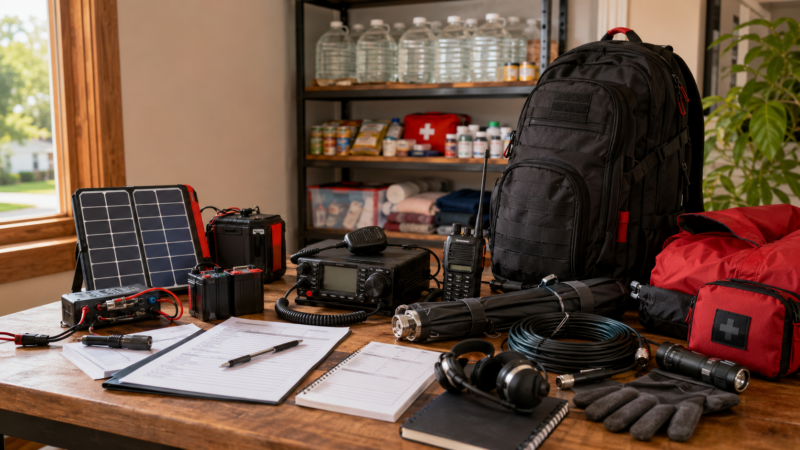
Plan in two layers: a 72-hour communications module and at least two weeks of household readiness. Agency instructions control what deploys. Pack for mobility, weather, medical needs, and safe power—not for an equipment show.
Medicines, glasses or hearing supplies, first aid, water, food, sanitation, clothing, rain gear, gloves, sturdy footwear, and sleep system.
Required high-visibility garment and PPE; light, cash, notebook, pencils, tape, and ICS/message-log forms.
Radio and Data
Programmed radio; headset; fuses; adapters; interface cables; feed-line; portable antenna and support; grounding and weather protection.
Laptop or tablet with current software, charging, offline forms, time synchronization, and tested Winlink configuration—plus paper backup.
Printed channel plan and contacts; labeled equipment; only authorized frequencies and credentials.
Power
Charged, known-capacity batteries; fused distribution; standard connectors; meter; chargers; and a plan for charger noise.
Solar or a power station may extend endurance. Generators require fuel, maintenance, approved outdoor placement, and site permission.
Load-test the whole station; high-duty-cycle digital transmission drains batteries much faster than receiving.
Portable power comparison
Source
Advantages
Limitations
Best preparation step
LiFePO4 battery
Light for usable capacity; stable voltage; many cycles.
Requires compatible charging and cold-weather awareness.
Measure real station runtime and fuse at the battery.
Sealed lead-acid
Simple, familiar, and widely available.
Heavy; less usable capacity at high load; shorter cycle life.
Load-test regularly and replace aging batteries.
Portable power station
Integrated charging, display, DC and AC outputs.
Inverter noise, proprietary limits, and misleading headline capacity can affect use.
Test receiver noise and runtime before deployment.
Solar
Silent renewable charging and useful for extended operations.
Weather, shade, panel angle, and charge-controller noise.
Practice a full charge cycle in realistic conditions.
Generator
High continuous output and fast resupply when fuel is available.
Noise, exhaust, fuel logistics, maintenance, and safety controls.
Use only in an approved outdoor location under the site safety plan.
Earthquake and Ham-Radio Myths
Common myths and planning facts
Myth
Planning fact
“A big New Madrid quake will destroy Chicago.”
Chicago is far from the zone. Direct effects are expected to be lower than in southern Illinois, while lifeline, inspection, communications, and mutual-aid consequences may still be significant.
“A quiet fault is overdue.”
Earthquakes do not follow a dependable appointment calendar. Probability estimates express uncertainty and do not predict a date.
“A handheld radio is an emergency plan.”
A useful operator also needs training, an assignment, antenna and power options, message discipline, logs, and personal sustainment.
“Ham Radio takes over when phones fail.”
Emergency managers select the best available path. Amateur Radio supplements authorized systems for specific gaps.
“More power is always better.”
Illinois ARES guidance calls for the minimum RF power necessary, conserving energy and reducing interference.[18]
A SARC Emergency-Preparedness Roadmap
SARC already has the foundation: an EMCOMM committee, repeaters covering much of Chicago’s northwest suburbs, directed weekly nets, and SARC in the Park sessions that test portable stations under non-ideal conditions.[15][24][25] The next step is to connect those activities into a repeatable qualification path.
---
config:
  markdownAutoWrap: true
  flowchart:
    wrappingWidth: 220
    useMaxWidth: true
    nodeSpacing: 40
    rankSpacing: 50
---
flowchart TD
    A["`Join SARC
nets`"]

    B["`Complete ICS-100, ICS-200,
ICS-700, and ICS-800`"]

    C["`Build and test a portable
VHF/UHF station`"]

    D["`Practice directed nets
and ICS-213 traffic`"]

    E["`Configure and exercise
Winlink`"]

    F["`Participate in SARC in the Park
and public-service activities`"]

    G["`Register with local ARES/RACES
or an affiliated agency`"]

    H["`Take part in tabletop, SET,
and earthquake exercises`"]

    I["`Complete an after-action review
and annual requalification`"]

    A --> B
    B --> C
    C --> D
    D --> E
    E --> F
    F --> G
    G --> H
    H --> I
Suggested Annual Club Exercises
SARC annual emergency-communications program
When
Exercise
Measurable objective
Quarterly
Twenty-minute message-handling drill during or after a regular net.
Pass an ICS-213 without changing names, numbers, priority, or meaning; complete a message log.
Spring
Portable-power and simplex coverage day at SARC in the Park.
Operate for four hours without commercial power and document coverage from assigned sites.
Summer
Winlink gateway and peer-to-peer exercise.
Send a structured form by two paths and demonstrate offline recovery of the message.
Autumn
New Madrid tabletop or Simulated Emergency Test.
Staff net control, EOC, shelter, and field roles through two operational periods with shift relief.
Yearly
Served-agency planning meeting and after-action review.
Emergency Communications: committee goals, ICS recommendations, and pathways into ARES, RACES, SATERN, AUXCOMM, and CERT.
SARC Nets: practice directed-net procedure and maintain operator familiarity.
SARC Repeaters: verify current frequency, offset, tone, and mode information before every exercise.
SARC in the Park: test go-boxes, antennas, batteries, and operator workflow away from the home station.
SARC Calendar: watch for nets, meetings, portable events, and training opportunities.
Call to Action: Train Before the Ground Moves
A New Madrid earthquake is a low-frequency, high-consequence scenario—not a reason for alarm. Build a two-week household plan, secure heavy contents, practice drop-cover-hold, and maintain medicines and family communications. Build radio capability in layers: reliable local operation, portable power, a practiced antenna, formal message skills, Winlink, and ICS familiarity.
SARC members can start by checking into a directed net, operating battery-powered at SARC in the Park, completing core FEMA courses, and joining the next EMCOMM exercise. Those seeking deployment should enroll with the appropriate ARES, RACES, AUXCOMM, CERT, SATERN, or served-agency program.
A disciplined operator who listens, follows direction, sends an exact message, and documents it is more valuable than elaborate untested equipment. SARC’s contribution is a dependable team that is known, trained, safe, and ready to serve.
U.S. Geological Survey, McBride and others, “Investigating Possible Earthquake-Related Structure Associated with the November 9, 1968, South-Central Illinois Earthquake.” https://pubs.usgs.gov/publication/70019838. Accessed July 20, 2026. Return to article.
SARC logged 1,675 contacts with 75 participants in class 2A, combining strong operating results with public-service, emergency-readiness, education, and outreach bonuses.
Preliminary result · Final ARRL standing pending
7,153 Preliminary total score
1,675 Total contacts
75 Participants
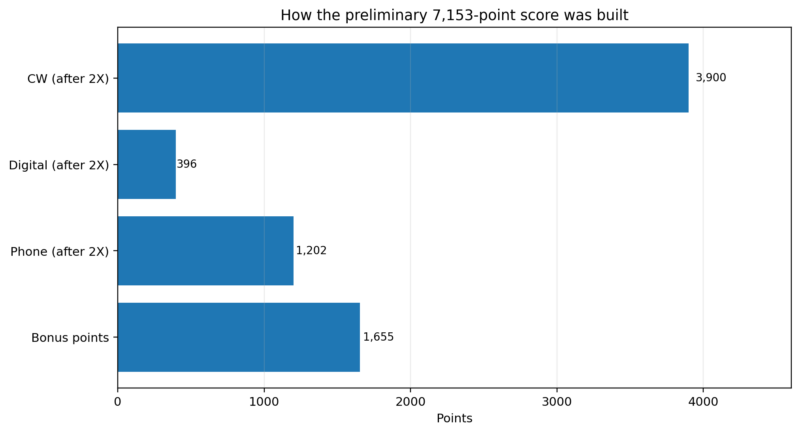
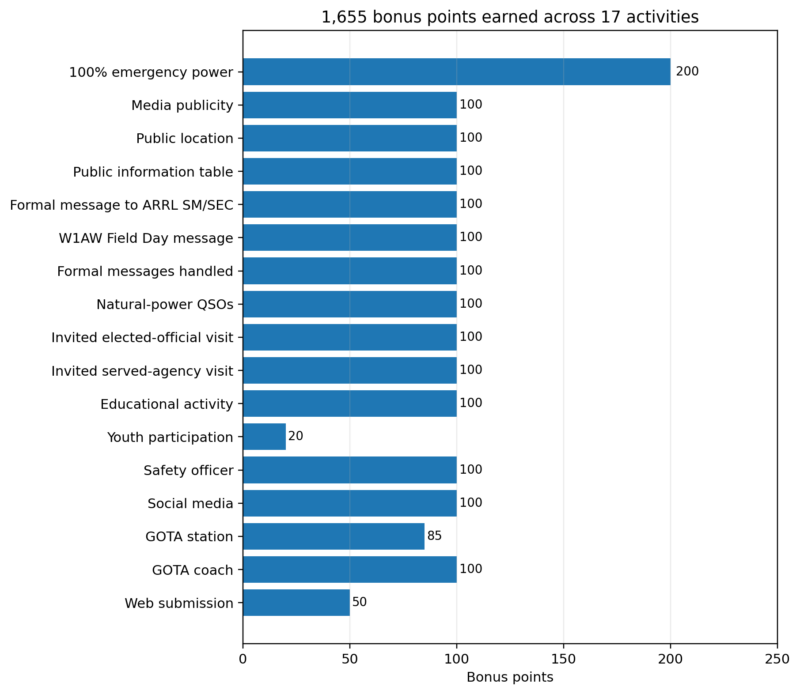
1,655 Bonus points
SARC’s 2026 operation produced 2,749 QSO points. The 2X power multiplier raised that operating score to 5,498 points, and 1,655 bonus points brought the preliminary total to 7,153.
SARC Image Sphere
40 images · WordPress Media Library
Drag to rotate · Wheel to zoom · Click an image for a large popup · Hover on an image for 1.5 seconds for a preview.
Waiting until the sphere is near the viewport…No image selected
Information and controls open as popups when their buttons are hovered, focused, or clicked.
How the score was built
Operating score
5,498 points after the 2X multiplier
CW supplied 3,900 multiplied points, phone supplied 1,202, and digital supplied 396.
Bonus score
1,655points from 17 activities
Bonuses rewarded emergency power, public engagement, message handling, natural power, safety, education, youth participation, GOTA, and more.
The operating score accounted for 76.9% of the total; bonus achievements accounted for 23.1%.
Contacts by mode and band
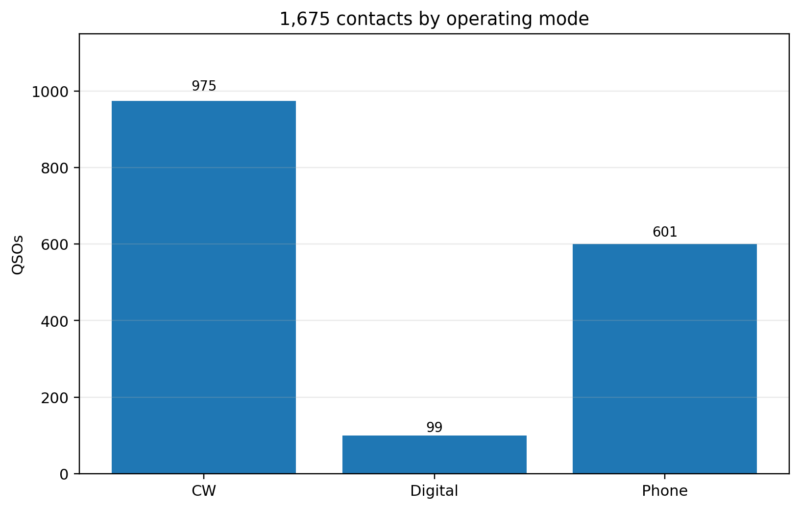
CW led the operation with 975 contacts, followed by 601 phone contacts and 99 digital contacts. Phone includes 584 contacts in the main SSB log plus 17 contacts at the GOTA station.
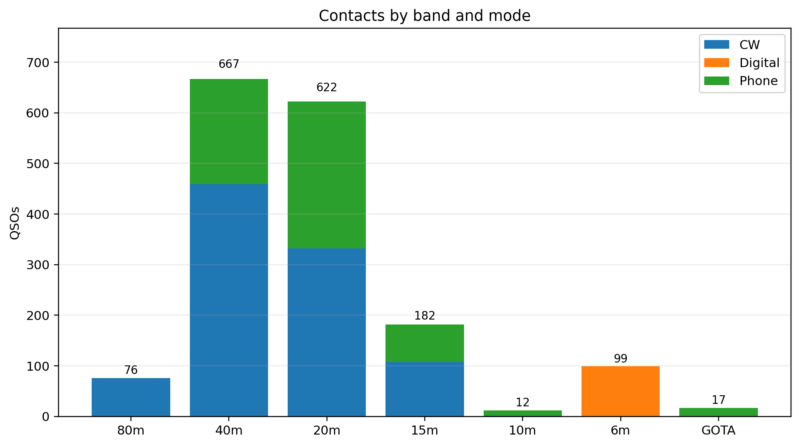
CW represented 58.2% of all contacts, phone 35.9%, and digital 5.9%.40 meters produced 667 contacts and 20 meters produced 622, making them the two busiest bands.
Station snapshot: 2A · Illinois Section · generator power · 100-watt entries · GOTA call KD9FMN · final ARRL placement pending.
Three years of score growth
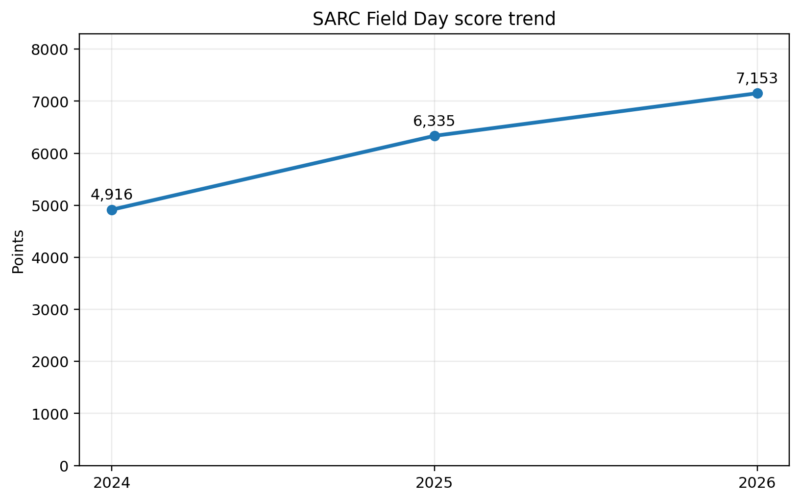
The 2026 preliminary score is 12.9% above 2025 and 45.5% above 2024. SARC’s reported final rankings were 19th of 297 in class 2A in 2025 and 36th of 289 in 2024.
The 2026 value is preliminary. Percentage changes shown here are recalculated from the stated annual scores.
Bonus points show the full Field Day mission
The bonus total reflects far more than contact volume. SARC documented emergency-power operation, media coverage, a public location and information table, formal traffic, the W1AW bulletin, natural-power contacts, invited visitors, education, safety, social media, youth participation, GOTA coaching, and web submission.
Emergency power was the largest single bonus at 200 points; most qualifying activities earned 100 points each.
Bonus activity
Points
100% emergency power
200
Media publicity
100
Public location
100
Public information table
100
Formal message to ARRL SM/SEC
100
W1AW Field Day message
100
Formal messages handled
100
Natural-power QSOs
100
Invited elected-official visit
100
Invited served-agency visit
100
Educational activity
100
Youth participation
20
Safety officer
100
Social media
100
GOTA station
85
GOTA coach
100
Web submission
50
Total bonus points
1,655
Station highlights
CW: 975 contacts
The CW station generated 1,950 QSO points before the multiplier. Four operators kept the station active across the full 24-hour period, and the first 10 contacts were completed on solar power before switching to generator power.
Phone: 601 contacts
The main SSB log recorded 584 contacts across 66 ARRL/RAC sections and eight countries or entities. The GOTA station added 17 phone contacts.
Digital: 99 contacts
All submitted digital contacts were made on 6 meters, adding 198 QSO points before the multiplier and 396 points after it.
GOTA: 17 contacts
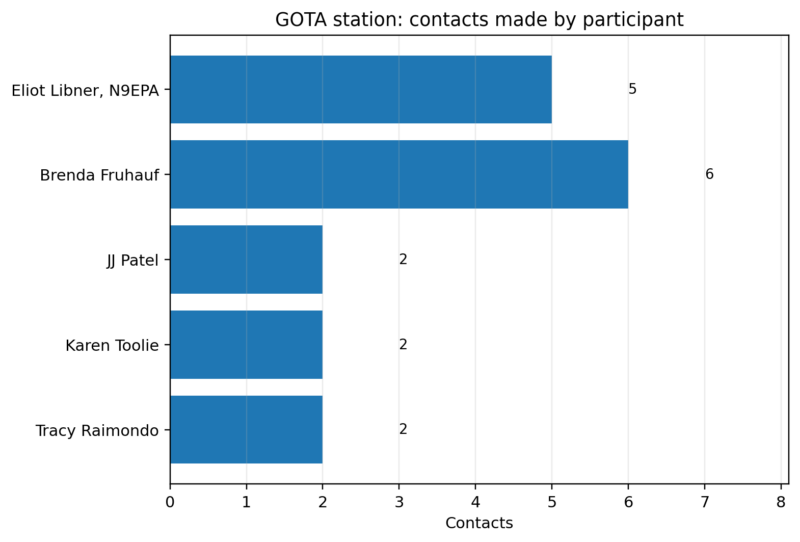
Five GOTA participants made contacts on 15, 20, and 40 meters. Their 85 contact bonus, together with the 100-point coach bonus, produced 185 GOTA-related bonus points.
Phone reach and operator effort
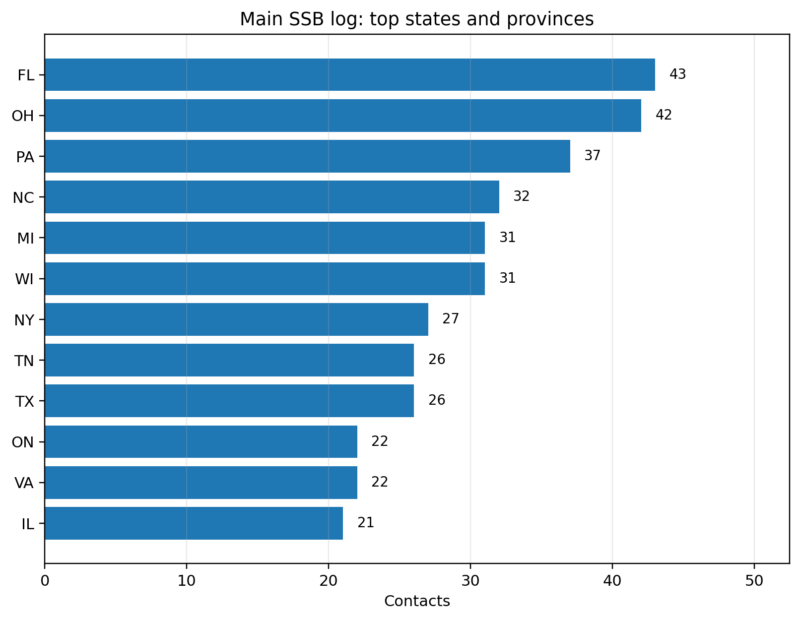
The main SSB station’s 584-contact log reached 49 states or provinces and eight countries or entities. Florida led the state/province count with 43 contacts, followed by Ohio with 42 and Pennsylvania with 37.
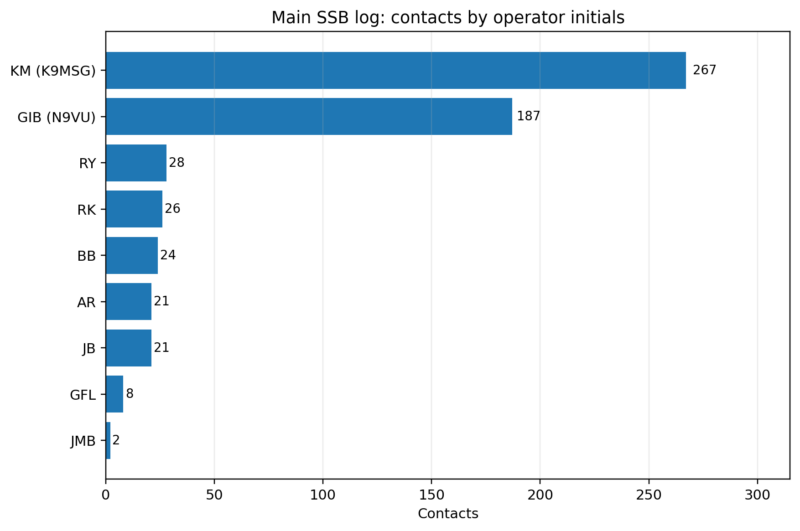
Top states and provinces in the 584-contact main SSB log.The two busiest operator entries accounted for 454 contacts, or 77.7% of the main SSB log.
GOTA spotlight
The Get On The Air station used call sign KD9FMN and gave new and returning operators a supervised way to experience Field Day. The station completed 17 contacts: nine on 20 meters, six on 15 meters, and two on 40 meters.
Five participants shared the GOTA microphone and completed all 17 contacts.
Sources:
ARRL Field Day entry confirmation for N9RJV, submitted July 14, 2026;
N3FJP SSB contest summary; SARC CW and GOTA station reports;